


Blog
What Is Shopify Plus and When Should a D2C Brand Upgrade?

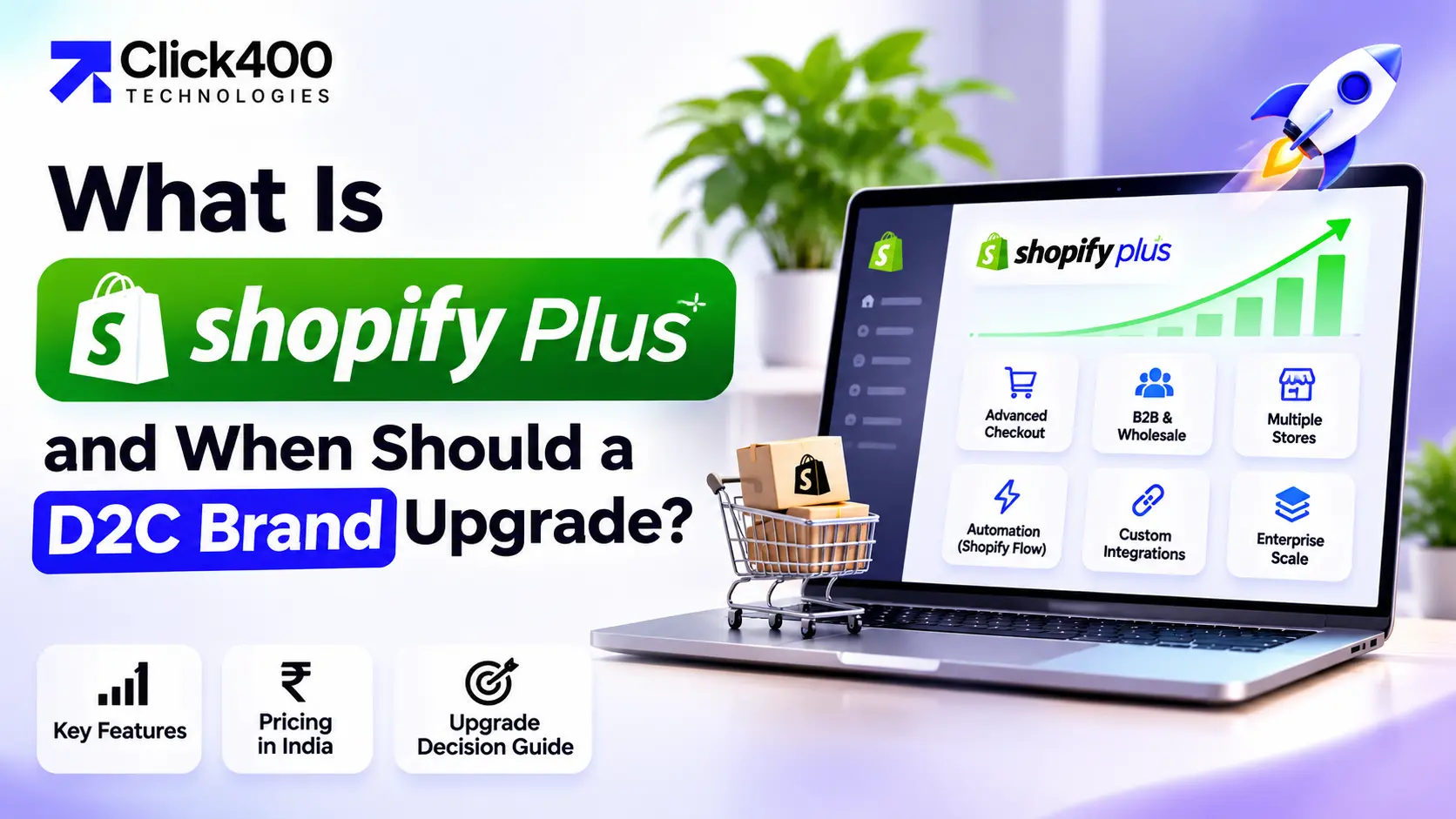
Your D2C brand is growing. Orders are increasing, marketing campaigns are generating more customers, and your ecommerce operations are becoming more complex.
But as your business expands, your existing Shopify setup may no longer provide everything your team needs.
You might want to customise your checkout, manage multiple storefronts, connect your store with an ERP system, introduce wholesale pricing, or automate complicated business operations.
This is where Shopify Plus becomes relevant.
Shopify Plus is Shopify’s enterprise commerce platform for businesses that need advanced ecommerce capabilities, greater operational flexibility, and more control over complex selling requirements.
However, upgrading to Shopify Plus is not a decision every growing D2C brand should make immediately. The subscription investment is significantly higher than standard Shopify plans, and the additional features only create value when they solve real business problems.
So, when should you upgrade? What additional capabilities do you actually get? And is Shopify Plus worth the investment for an Indian D2C brand?
In this guide, Click400 Technologies explains Shopify Plus through practical business scenarios, actual platform capabilities, pricing considerations, and an upgrade decision framework.
What Is Shopify Plus?
Shopify Plus is the enterprise-level offering within Shopify’s ecommerce platform. It is designed for established and high-growth businesses that need more advanced tools to manage their online stores and commerce operations.
Unlike standard Shopify plans, Shopify Plus provides additional capabilities for checkout customisation, organisation management, B2B selling, expansion stores, advanced integrations, and enterprise workflows.
For example, imagine an Indian fashion brand that started with a single Shopify store.
Initially, the business had:
- One ecommerce website.
- A small product catalogue.
- A limited operations team.
- Standard payment and shipping integrations.
After several years, the brand expands.
Now it manages thousands of orders, sells internationally, supplies wholesale buyers, runs large promotional campaigns, and connects its website with inventory and accounting systems.
The original ecommerce setup may no longer be suitable for every operational requirement.
Shopify Plus provides additional tools to manage this complexity without necessarily moving to a completely different ecommerce platform.
What Makes Shopify Plus Different?
Its value comes from several additional capabilities:
- Advanced checkout customisation.
- Higher API limits for complex integrations.
- Organisation-level store management.
- Up to nine expansion stores under eligible standard Plus contracts.
- Unlimited staff accounts.
- Custom user groups and permissions.
- Advanced B2B catalogue and payment capabilities.
- Enterprise-oriented reporting and operational tools.
- Additional custom development opportunities.
In simple terms: Shopify Plus is designed for businesses that have outgrown the capabilities of their existing ecommerce setup and need more control over how their commerce operations work.
Shopify vs Shopify Advanced vs Shopify Plus: What Is the Difference?
One of the biggest mistakes D2C founders make is assuming that every successful ecommerce business needs Shopify Plus.
That is not true.
Shopify Advanced already provides a strong set of ecommerce features, including international selling capabilities, advanced reporting, and support for growing teams.
Shopify Plus adds capabilities for businesses with more specialised requirements.
| Feature | Shopify Advanced | Shopify Plus |
|---|---|---|
| Online store | Included | Included |
| Unlimited products | Yes | Yes |
| Standard ecommerce SEO | Yes | Yes |
| International selling | Yes | Yes |
| Advanced reports | Yes | Yes, additional capabilities |
| Staff accounts | Up to 15 | Unlimited |
| Checkout customisation | More limited | Advanced |
| Checkout UI extensions on information, shipping and payment steps | No | Yes |
| B2B catalogue assignments | Up to 3 active assignments across active B2B markets | Unlimited |
| Direct company-specific B2B catalogues | No | Yes |
| Deposits and partial B2B payments | No | Yes |
| Expansion stores | Not included as a Plus benefit | Up to 9 |
| Custom user groups | No | Yes |
| Higher API capacity | Standard | Higher limits |
An important distinction is that Shopify B2B and Shopify Flow are not exclusive to Plus. Several B2B features and automation capabilities are already available on standard plans.
Shopify Plus becomes more valuable when you need the additional capabilities that standard plans do not provide.
For current feature availability, refer to Shopify’s official B2B plan comparison and Shopify Plus documentation.
How Much Does Shopify Plus Cost in India?
Shopify Plus is a significant investment compared with standard Shopify subscriptions.
According to Shopify’s published India pricing, the starting subscription is:
| Contract duration | Starting monthly price |
|---|---|
| 1-year term | ₹1,90,000 |
| 3-year term | ₹1,75,000 |
These are published starting prices for standard setups and integrations. More complex businesses may have variable platform fees depending on their revenue and business model.
Taxes, payment-related fees, development, and third-party applications may add to the overall cost.
For the latest pricing, visit the official Shopify Plus pricing page.
What Does a Shopify Plus Budget Actually Include?
The subscription is only one part of your ecommerce investment.
A growing D2C business may also need:
- Shopify Plus subscription.
- Custom Shopify theme development.
- Checkout customisation.
- ERP and CRM integrations.
- Inventory management integration.
- Third-party applications.
- International storefront development.
- Ongoing technical support.
- Conversion rate optimisation.
For example, a brand upgrading to Shopify Plus may want to connect its ecommerce store with an ERP system, introduce company-specific wholesale pricing, and build a custom checkout experience.
The subscription provides access to the relevant platform capabilities, but the actual implementation may require additional development.
Our recommendation: Evaluate Shopify Plus based on the total cost of ownership, not just the monthly subscription.
7 Shopify Plus Features That Actually Matter for Growing D2C Brands
Not every feature available on Shopify Plus will be relevant to every business.
The following seven capabilities are particularly important when a D2C brand starts managing more complex ecommerce operations.
1. Advanced Checkout Customisation
Checkout is one of the most important stages of the customer buying journey.
A customer discovers your product, visits your website, adds an item to the cart, and proceeds to checkout.
If your checkout does not support the experience your business requires, it may create unnecessary friction.
Shopify Plus provides additional checkout customisation capabilities through Shopify’s Checkout Branding API and checkout extensions.
Businesses can implement supported custom experiences across checkout steps, including information, shipping, and payment.
For example, an Indian D2C brand may need a specialised checkout workflow that integrates additional shipping or payment functionality.
A premium brand may also want a more consistent visual experience between its storefront and checkout.
These requirements need to be planned and implemented by developers using supported Shopify extension points.
Why it matters: Shopify Plus gives growing businesses more flexibility to develop checkout experiences around their operational and customer requirements.
However, upgrading alone does not guarantee higher conversion rates. The actual customer experience and implementation determine the results.
2. Multiple Storefronts Through Expansion Stores
International expansion can introduce operational complexity.
You may need different storefronts for different regions, languages, currencies, and customer experiences.
Shopify Plus supports expansion stores that can operate under the same organisation and contract.
Under a standard Plus contract, businesses can have up to ten stores in total: one main store and nine expansion stores.
For example, an Indian fashion brand could operate separate storefronts for:
- India.
- United States.
- Australia.
- United Kingdom.
Each store can have its own configuration and storefront experience.
However, expansion stores do not automatically share products, inventory, settings, or customer data. Additional integrations may be needed to synchronise information.
Another important consideration is that expansion stores are intended for eligible extensions of the same brand, not for operating unrelated brands under one contract.
Learn more in Shopify’s official expansion store documentation.
3. Advanced B2B and Wholesale Selling
Many successful D2C brands eventually expand into wholesale.
For example, a skincare brand may initially sell products directly to customers through its website.
Later, it starts supplying salons, retailers, and distributors.
These customer groups may need different pricing, payment arrangements, and purchasing experiences.
Shopify B2B is available on multiple Shopify plans, but Shopify Plus offers additional functionality for more complex wholesale operations.
Some Plus-specific capabilities include:
- Unlimited B2B catalogue assignments.
- Direct catalogue assignments to individual companies and locations.
- Deposit requirements.
- Partial payments.
- Payment requests per fulfilment.
This is particularly useful for manufacturers, furniture brands, fashion wholesalers, and consumer product companies that operate both D2C and B2B channels.
4. Higher API Limits and Enterprise Integrations
A growing ecommerce business rarely operates through Shopify alone.
Your website may need to communicate with:
- ERP software.
- CRM systems.
- Inventory management tools.
- Warehouse management systems.
- Accounting applications.
- Marketing automation platforms.
- Shipping and fulfilment systems.
When these integrations become more complex, standard API limits and existing workflows may need to be evaluated.
Shopify Plus provides higher API limits than standard plans, helping support more demanding integration requirements.
For example, a furniture company managing multiple inventory locations may need to synchronise stock availability, orders, and fulfilment information between Shopify and its ERP system.
The goal is to reduce manual work and maintain more accurate operational data.
5. Unlimited Staff Accounts and Custom Permissions
As a D2C business expands, more people become involved in ecommerce operations.
Your marketing team may manage campaigns, the operations team may process orders, and external developers may maintain the storefront.
Shopify Plus provides unlimited staff accounts and custom user groups.
This helps businesses organise access based on different team responsibilities.
For example:
- Marketing employees manage relevant marketing activities.
- Operations employees manage fulfilment-related tasks.
- Finance employees access relevant financial information.
- Development partners receive appropriate technical access.
This is especially useful for businesses with larger teams and multiple storefronts.
6. Shopify Flow and Advanced Business Automation
Manual operations become increasingly difficult as order volumes grow.
Shopify Flow helps automate repetitive tasks using triggers, conditions, and actions.
For example, a business could create workflows to:
- Tag high-value customers.
- Flag potentially risky orders.
- Send internal notifications.
- Automate selected inventory-related actions.
- Organise customers into segments.
- Trigger fulfilment-related tasks.
Shopify Flow is available on multiple Shopify plans, so it should not be treated as an exclusive Plus feature.
The advantage of Shopify Plus is the broader set of enterprise capabilities that can be combined with automation.
7. Headless Commerce and Custom Storefront Experiences
Some established brands require more control over their frontend shopping experience.
This is where headless commerce becomes relevant.
In a traditional Shopify storefront, the frontend and ecommerce backend work within Shopify’s storefront architecture.
In a headless setup, the frontend is developed separately and communicates with Shopify through APIs.
This allows developers to build highly customised shopping experiences using their preferred frontend technology.
For example, a premium furniture brand may want a highly interactive product experience with advanced product visualisation, custom content, and specialised browsing functionality.
Shopify Plus supports advanced headless commerce options, including Hydrogen and Oxygen.
However, headless commerce is not necessary for most D2C businesses. It introduces additional development, maintenance, and technical responsibilities.
Choose it when the business requirements justify the complexity.
When Should a D2C Brand Upgrade to Shopify Plus?
This is where the upgrade decision becomes important.
There is no universal revenue threshold that automatically makes a business eligible or ready for Shopify Plus.
A brand generating ₹50 lakh per month may have simple ecommerce operations, while another brand generating ₹20 lakh per month may have complicated B2B, checkout, and integration requirements.
The right decision depends on the problems your current Shopify plan cannot solve efficiently.
Here are six situations where Shopify Plus deserves serious consideration.
1. Your Business Needs Advanced Checkout Functionality
If your existing checkout setup cannot support important business requirements, Plus may provide the flexibility you need.
Examples include custom checkout extensions for information, shipping, and payment steps.
2. You Are Expanding into Multiple Markets
If your brand is selling across several countries and needs separate storefront experiences, expansion stores may become valuable.
3. You Are Building a Wholesale Business Alongside D2C
If your business needs more advanced company-specific pricing, wholesale catalogues, deposits, and partial payments, Shopify Plus can support these requirements.
4. Your Business Depends on Complex Integrations
If Shopify needs to communicate with several enterprise systems, higher API capacity and custom integration architecture may become important.
5. Your Team Needs More Advanced Store Management
If multiple teams, departments, and external partners are involved, unlimited staff accounts and custom user groups can help organise operations.
6. Your Current Platform Setup Is Creating Operational Limitations
If your team spends too much time managing workarounds, manually synchronising information, or maintaining complex integrations, it may be time to evaluate whether Plus can simplify the overall setup.
The important point is to identify the actual limitation first.
Do not upgrade simply because your competitors use Shopify Plus.
Shopify Advanced vs Shopify Plus: Which One Should Your Brand Choose?
Before spending more on your ecommerce platform, understand whether your existing Shopify plan already supports your business.
Here is a practical way to evaluate the decision.
| Business situation | Recommended approach |
|---|---|
| New D2C brand | Start with a standard Shopify plan |
| Growing store with one storefront | Evaluate Shopify Grow or Advanced |
| Established brand with standard integrations | Shopify Advanced may be sufficient |
| Business requiring advanced checkout extensions | Consider Shopify Plus |
| Complex wholesale operations | Evaluate Shopify Plus |
| Multiple eligible regional storefronts | Consider Shopify Plus |
| Enterprise-level integration requirements | Evaluate Shopify Plus |
| Simple product catalogue and standard checkout | Standard Shopify may be sufficient |
The best Shopify plan is the one that solves your current business requirements without creating unnecessary technology expenses.
Is Shopify Plus Worth It for Indian D2C Brands?
For Indian D2C brands, Shopify Plus can be valuable when the business has specific operational requirements that justify its cost.
Consider these examples.
Fashion and clothing brands
A fashion business expanding internationally may need multiple regional storefronts, different product collections, and more advanced operational management.
Beauty and personal care brands
A growing beauty brand may require advanced checkout customisation, complex integrations, and more sophisticated customer experiences.
Furniture and home décor brands
A furniture manufacturer selling directly to customers and wholesale buyers may benefit from advanced B2B catalogues, custom pricing, and payment arrangements.
Food and beverage brands
A high-volume food brand may require advanced integrations, inventory workflows, and operational automation.
Jewellery brands
An established jewellery business may need international storefronts, custom integrations, and specialised customer purchasing experiences.
The important consideration is not the industry itself. It is the complexity of the business model.
A small jewellery brand may work perfectly well on Shopify Advanced, while a large furniture business may have a strong reason to upgrade to Plus.
What Should You Check Before Upgrading to Shopify Plus?
Upgrading your Shopify plan without evaluating your existing store can lead to unnecessary expenses.
Before moving to Plus, review these areas.
1. Existing Store Architecture
Check your current theme, custom code, applications, and integrations.
2. Checkout Requirements
Identify which checkout limitations are affecting your customer experience or business operations.
3. API and Integration Requirements
Understand how your existing systems communicate with Shopify and whether additional API capacity is actually required.
4. International Store Requirements
Determine whether you need expansion stores or whether Shopify Markets already supports your selling strategy.
5. B2B Requirements
Review your wholesale catalogue, customer-specific pricing, and payment requirements.
6. Total Cost of Ownership
Calculate subscription costs, application expenses, development, maintenance, and additional operational costs.
7. Expected Business Value
Identify measurable improvements such as reduced manual work, better operational efficiency, and improved customer experience.
A proper technical and commercial assessment should happen before signing a long-term contract.
Frequently Asked Questions About Shopify Plus
What is Shopify Plus in simple words?
Shopify Plus is Shopify’s enterprise commerce offering for businesses that need additional ecommerce capabilities, advanced checkout customisation, complex integrations, B2B functionality, and more advanced store management.
How much does Shopify Plus cost in India?
Shopify Plus starts at ₹1,75,000 per month on a three-year term or ₹1,90,000 per month on a one-year term, according to Shopify’s published India pricing. More complex businesses may have variable platform fees.
When should a D2C brand upgrade to Shopify Plus?
A D2C brand should consider upgrading when it needs features that its existing Shopify plan cannot provide efficiently, such as advanced checkout extensions, more complex B2B functionality, expansion stores, or enterprise integrations.
Is Shopify Plus better than Shopify Advanced?
Shopify Plus offers additional enterprise capabilities, but Shopify Advanced is sufficient for many established D2C businesses. The right choice depends on your operational requirements rather than revenue alone.
Does Shopify Plus increase website speed?
Shopify Plus provides enterprise-oriented platform capabilities, but it does not automatically make a storefront faster. Theme quality, applications, scripts, and technical implementation still affect performance.
Can I use Shopify Plus for B2B and D2C together?
Yes. Shopify Plus supports more advanced B2B and D2C operations, including company-specific catalogues and additional payment capabilities.
Does Shopify Plus support international selling?
Yes. Shopify Plus supports expansion stores for eligible international storefronts, alongside Shopify Markets capabilities. Each expansion store has its own configuration and data.
Do I need to redesign my website after upgrading?
No. Upgrading your plan does not automatically require a website redesign. You can continue using your existing storefront and implement additional functionality when needed.
Is Shopify Plus suitable for a business generating ₹10 lakh per month?
It may be, but revenue alone does not determine whether Plus is suitable. Evaluate your checkout requirements, B2B operations, integrations, and the financial value of the additional features.
Do I need a Shopify Plus development agency?
An experienced development agency can help with Plus implementation, checkout customisation, custom themes, integrations, B2B workflows, and performance optimisation. The need depends on your technical requirements.
Scale Your D2C Brand with Click400 Technologies
Choosing Shopify Plus is an important technology decision, but building the right ecommerce experience is equally important.
At Click400 Technologies, we help D2C brands build, redesign, and scale Shopify ecommerce stores with a focus on performance, customer experience, and conversion.
Our ecommerce services include:
- Shopify Plus development.
- Custom Shopify theme development.
- Shopify website redesign.
- Advanced Shopify UI/UX design.
- Shopify checkout customisation.
- Shopify app and API integrations.
- Shopify speed optimisation.
- Ecommerce conversion rate optimisation.
- WooCommerce to Shopify migration.
- Ecommerce SEO and AI-powered SEO.
Whether you are planning to upgrade from Shopify Advanced or build a new Shopify Plus store, we can help evaluate your requirements and plan the right development approach.
Planning to upgrade your Shopify store?
Visit https://click400.com/ to explore Click400’s Shopify development services and portfolio or discuss your ecommerce requirements with our team.