


Blog
Flat Rate vs. Calculated Shipping: Which Is Better for Shopify?
Shipping prices influence two important parts of an eCommerce business: customer purchasing decisions and order profitability. A delivery charge that is too high can discourage customers at checkout, while one that is too low can leave merchants covering the difference.
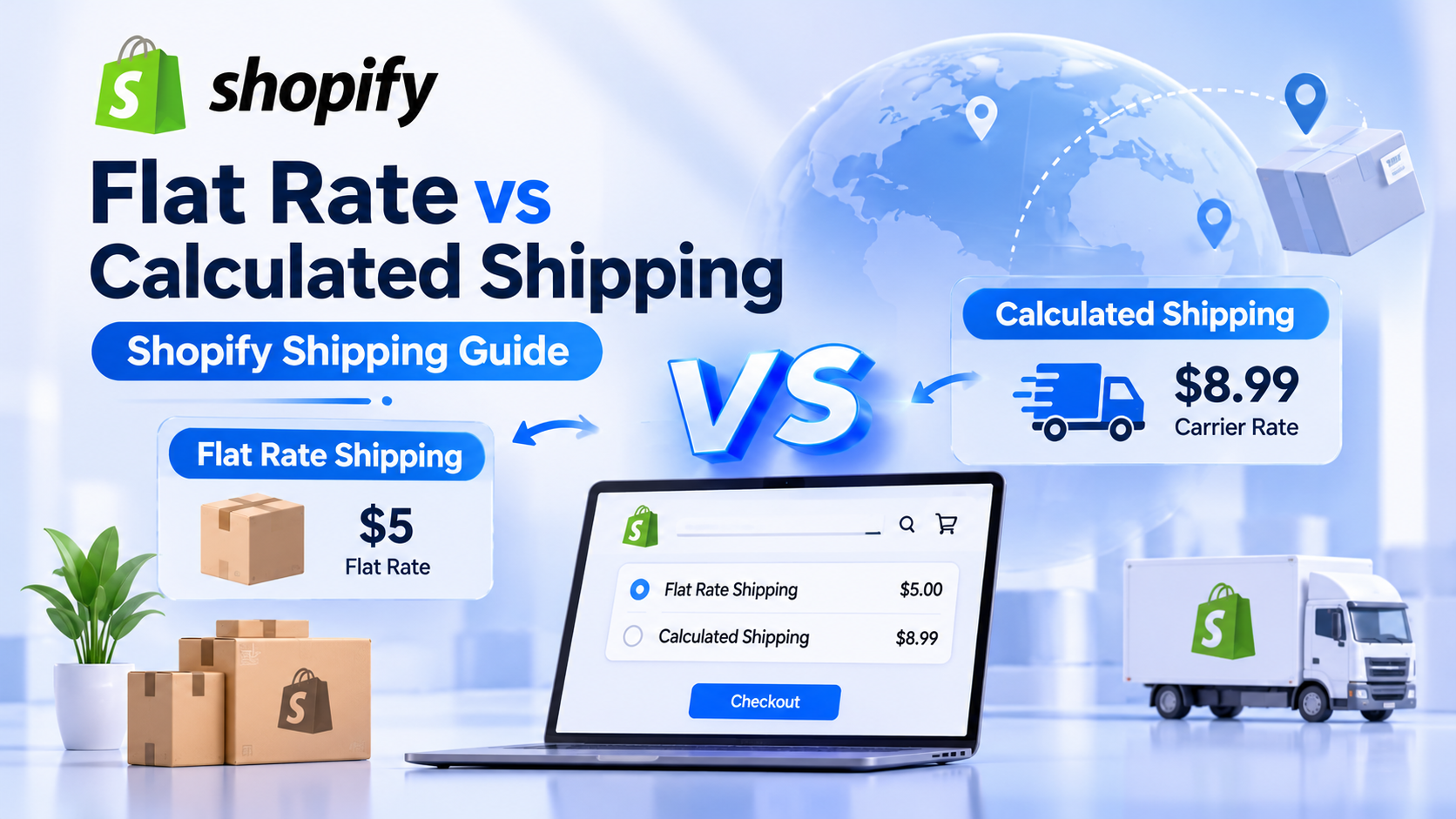
When comparing Shopify Flat Rate vs Calculated Shipping, the main difference is how delivery charges are determined. Flat rate shipping uses prices configured by the merchant, while calculated shipping displays rates returned by a supported carrier or shipping app. Each method serves a different business need, and the right choice depends on product sizes, delivery destinations, fulfilment costs, and pricing strategy.
What Is Flat Rate Shipping in Shopify?
Flat rate shipping allows merchants to set the delivery charges customers see at checkout. Instead of requesting a live carrier quote for every order, the store applies predefined shipping prices according to its shipping rules.
Shopify supports different types of flat rates, including:
A fixed delivery charge for eligible orders.
Different charges depending on the cart value.
Different charges depending on the applicable shipment weight.
No delivery charge when an order meets the configured conditions.
For example, a store might charge $7 for orders below $50, $5 for orders between $50 and $99.99, and offer free shipping on orders of $100 or more.
These are sample prices, not recommended rates for every store. Merchants should calculate their own charges using packaging, carrier, handling, and fulfilment expenses.
The main benefit is pricing control. You decide what customers pay for eligible orders, making it easier to plan promotions and communicate delivery charges before checkout.
What Is Calculated Shipping in Shopify?
Calculated shipping displays delivery prices returned by a supported shipping carrier or shipping app. The rate is determined using shipment information rather than relying only on a fixed price configured by the merchant.
Depending on the carrier and integration, the calculation can consider:
Shipping origin and destination
Shipment weight
Package dimensions
Dimensional weight
Selected delivery service
For example, shipping a small accessory to a nearby address may cost less than sending a large package across the country. Calculated rates can reflect these differences when the carrier or app supports the relevant shipment details.
Shopify offers certain built-in carrier integrations in supported regions. Merchants who want to connect their own carrier accounts may need third-party carrier-calculated shipping (CCS). This feature has specific plan requirements: it is available on Advanced and Plus, while Grow stores may add it for an additional fee or through annual billing.
Calculated shipping is useful when delivery costs vary significantly between orders. However, accurate product weights, package dimensions, and shipping origins are essential for reliable quotes.
Flat Rate vs. Calculated Shipping: Key Differences
Both methods determine what customers pay for delivery, but they differ in pricing control, flexibility, and operational requirements.
Comparison | Flat Rate Shipping | Calculated Shipping |
Price determination | Set by the merchant | Returned by a carrier or app |
Pricing control | Merchant controls the configured charge | Depends on carrier or app rates |
Cost consistency | Predictable for eligible orders | Can vary between shipments |
Shipment details | Conditions may use order value or weight | Can use weight, dimensions, and destination |
Setup requirements | Configure shipping rates and conditions | Requires a supported carrier or app integration |
Suitable for | Products with predictable delivery costs | Orders with varying shipment requirements |
The important distinction is that flat rate shipping follows rules established by the store, whereas calculated shipping responds to the details of an individual shipment.
Advantages and Limitations of Flat Rate Shipping
Flat rate shipping is useful when merchants want to keep delivery pricing consistent and manage the amount collected from customers.
Advantages
Customers can understand the delivery cost without waiting for a shipment-specific quote.
Merchants can create different rates based on order value or weight.
Free shipping thresholds and discounted delivery offers can be built into the pricing strategy.
The store can use its configured rates without requesting a carrier calculation for every eligible order.
Limitations
A fixed amount may not cover expensive deliveries, especially for heavy or oversized products.
Customers ordering lightweight products may pay more than the actual delivery expense.
Changes in carrier prices, packaging expenses, or fulfilment costs can make existing rates unprofitable.
A single rate may not work well when domestic and international delivery expenses vary considerably.
Flat rate shipping works best when the merchant has enough cost information to set realistic charges. The objective is not simply to make delivery prices consistent, but to ensure those prices remain financially sustainable.
Advantages and Limitations of Calculated Shipping
Calculated shipping is more suitable when the cost of delivering an order depends heavily on its physical characteristics and destination.
Advantages
Delivery prices can reflect the weight, dimensions, and destination of an order.
Merchants selling lightweight, heavy, and oversized products can avoid relying on one general shipping price.
Supported integrations may display multiple delivery services, such as standard and express options.
Merchants do not need to create a separate fixed price for every possible shipment combination.
Limitations
Incorrect product weights or package dimensions can result in unreliable rates.
Customers in different locations may see different delivery charges for the same product.
Carrier accounts, shipping apps, and Shopify plan eligibility can affect which calculated rates are available.
A carrier or app may occasionally fail to return a rate, requiring an appropriate alternative.
Calculated shipping can improve pricing accuracy, but it does not automatically account for every business expense. Packaging, handling, fulfilment, and other costs still need to be included when evaluating order profitability.
Which Shipping Method Is Better for Different Shopify Stores?
The most suitable option depends on the products being sold and the way orders are fulfilled.
Stores Selling Similar-Sized Products
Flat rate shipping is often a practical choice for stores selling products with comparable weights and packaging requirements.
For example, a stationery store selling notebooks, pens, and small desk accessories may have relatively consistent delivery expenses. A fixed standard shipping charge can make checkout pricing easier to manage.
The merchant should still review actual delivery costs to ensure the rate covers the majority of orders.
Stores Selling Heavy or Oversized Products
Calculated shipping may be more appropriate for businesses selling furniture, large appliances, equipment, or other products with significantly different package dimensions.
A small accessory and a large furniture item should not necessarily carry the same delivery charge. Carrier-calculated rates can account for shipment characteristics and destination when the integration supports them.
This approach helps avoid applying an unsuitable average rate to products with very different delivery requirements.
Stores Selling Internationally
International shipping can involve substantial differences in carrier prices, delivery services, and destination requirements.
Calculated rates can help display carrier quotes for supported international shipments. However, merchants should remember that a carrier shipping quote is not the same as the complete landed cost. Import duties, taxes, and customs-related charges may need separate calculation and communication.
Flat rates can also work for international orders when the merchant has reliable cost data and creates appropriate rates for different shipping destinations.
Can You Use Flat Rate and Calculated Shipping Together?
Yes. Shopify can display flat rates alongside eligible carrier- or app-calculated rates. This allows merchants to offer customers different delivery options when their shipping configuration supports them.
For example, a store could provide:
Standard shipping at a fixed price.
Express delivery using a calculated carrier rate.
This gives customers a choice between a predictable delivery charge and a carrier-based option.
There is one important distinction: a flat rate added alongside calculated rates is not necessarily a backup rate. Eligible flat rates can remain visible even when calculated rates are working. Shopify's backup rates are used when all applicable calculated rates fail and no other eligible rate is available.
Merchants should therefore review the displayed options carefully. Clear service names and realistic prices help customers understand what they are selecting at checkout.
How to Choose the Right Shipping Method
Before configuring shipping rates, evaluate these three areas of your business.
1. Review Your Actual Delivery Costs
Compare recent shipping expenses across different products, package sizes, and destinations. Include packaging and handling costs rather than looking only at the carrier's base price.
If expenses remain relatively consistent, flat rates may be easier to manage. If they change significantly between orders, calculated shipping deserves consideration.
2. Match the Method to Your Product Catalogue
Look at the range of products your store sells. Similar-sized products may work well with predefined rates, while a catalogue containing small, heavy, and oversized items may require shipment-specific pricing.
Also check whether your product weights and package dimensions are accurate before relying on calculated rates.
3. Consider Checkout Experience and Shopify Requirements
Review how delivery charges will appear to customers. A predictable price can make checkout easier to understand, but an unrealistic fixed charge may damage profitability.
If you plan to use carrier-calculated rates, confirm that the required carrier integration, shipping app, and Shopify plan are available for your store.
Conclusion
Choosing between flat rate and calculated shipping is a business decision, not simply a choice between fixed and variable prices.
Flat rate shipping is generally suitable when delivery expenses are predictable and merchants want greater control over customer-facing charges. Calculated shipping is more appropriate when product weight, package dimensions, and delivery destinations create significant differences in shipping costs.
Some Shopify stores can benefit from offering both methods, giving customers more flexibility at checkout.
The best approach is the one that reflects your actual fulfilment expenses, supports your product range, and presents clear delivery prices without unnecessarily reducing profit margins.
Share this article