


Blog
Best Shopify Attribution Tracking Apps for Better Conversions

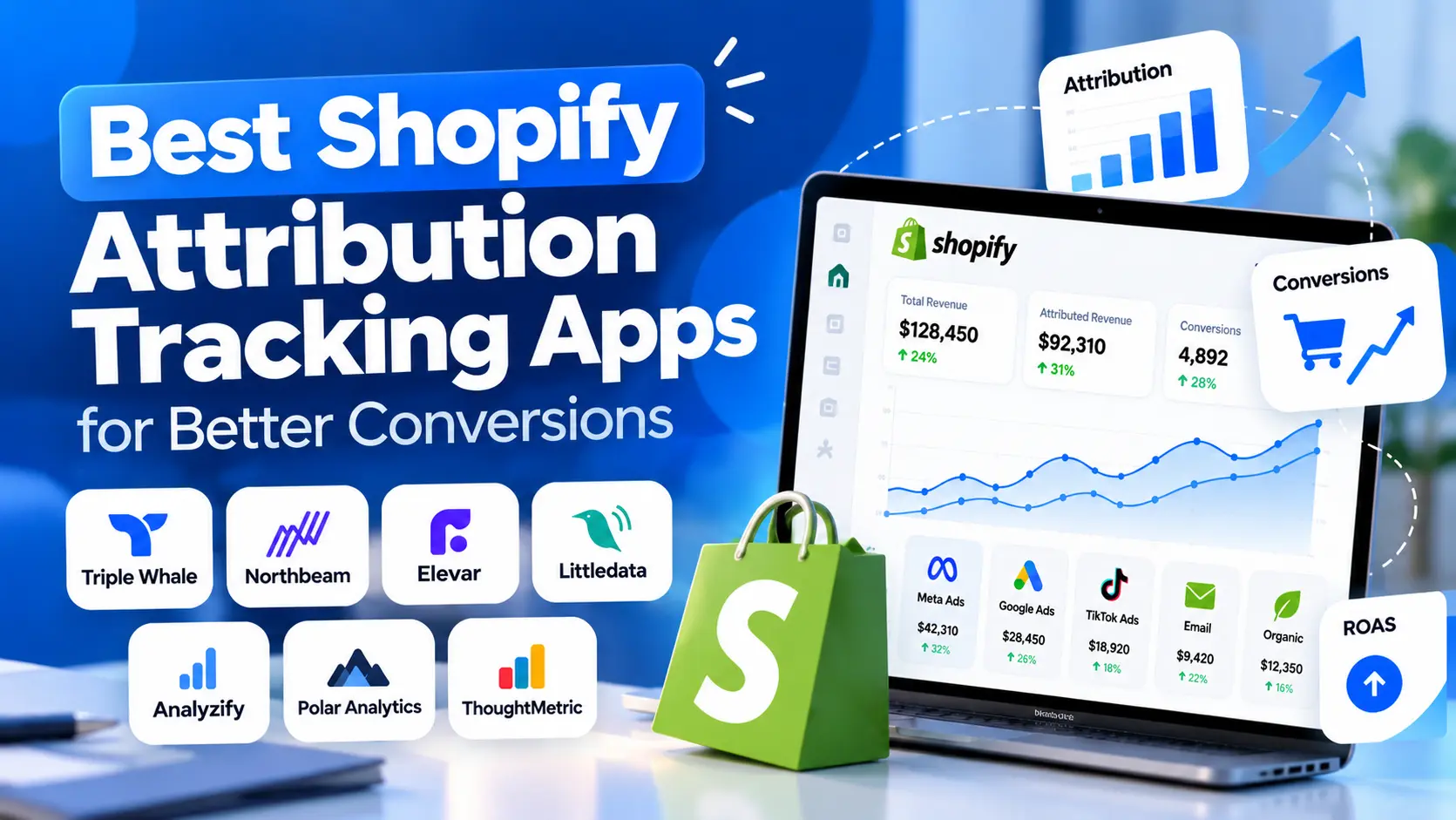
Choosing the Right Tracking Tools to Improve ROAS, Understand Customer Journeys, and Scale Your Shopify Store Profitably
Running a Shopify store in 2026 is no longer just about generating traffic and increasing sales. For growing D2C brands, the real challenge is understanding which marketing channels generate profitable customers and which campaigns are wasting advertising budgets.
Imagine spending ₹3 lakh every month on Meta Ads, Google Ads, and influencer marketing. Your Meta Ads Manager reports 150 purchases, Google Ads reports 100 conversions, and Shopify shows only 180 total orders.
Which platform is reporting accurately? Which campaign actually generated those sales? And where should you invest your next ₹50,000?
This is where Shopify attribution tracking and conversion tracking apps become essential.
The right tools help merchants measure customer interactions, improve conversion data quality, understand the customer journey, and make smarter marketing decisions.
In this guide, we’ll compare the best Shopify attribution tracking apps in 2026, explain their differences, and help you choose the right solution based on your store’s advertising budget, growth stage, and marketing channels.
Attribution Tracking vs Conversion Tracking: What’s the Difference?
Before choosing an app, it’s important to understand that attribution tracking and conversion tracking solve different problems.
| Attribution tracking | Conversion tracking |
|---|---|
| Identifies which marketing channels influence sales | Records customer actions such as purchases and add-to-cart events |
| Helps compare Meta, Google, TikTok, and other channels | Sends conversion events to advertising and analytics platforms |
| Supports budget allocation decisions | Improves the data available for ad optimization |
| Analyzes customer journeys and touchpoints | Uses pixels, APIs, tags, and event tracking |
| Examples: Triple Whale, Northbeam | Examples: Elevar, Analyzify |
For Shopify merchants: Conversion tracking tells advertising platforms what happened. Attribution tracking helps you understand which marketing activities contributed to making it happen.
Both are important, but not every Shopify store needs two separate paid tools.
7 Best Shopify Apps for Attribution and Conversion Tracking in 2026
1. Triple Whale — Best Overall for Growing D2C Brands

Triple Whale is a strong option for Shopify merchants who advertise across Meta, Google, and TikTok and want a clearer picture of marketing performance.
Its attribution dashboards, first-party tracking, and profitability reporting help merchants evaluate campaigns beyond the ROAS reported by individual ad platforms.
Key features:
- Multi-touch marketing attribution
- First-party pixel tracking
- Marketing and profitability dashboards
- Customer journey analysis
- AI-powered reporting and insights
Best for: Growing Shopify brands investing consistently in paid advertising.
Consider before installing: Advanced functionality can be expensive for smaller stores, and its attribution estimates may differ from advertising platform reports.
Website: triplewhale.com
2. Northbeam — Best for High-Ad-Spend Shopify Brands

Northbeam is designed for performance marketing teams managing complex advertising strategies.
Instead of relying only on platform-reported conversions, it provides advanced attribution and measurement capabilities to support decisions about campaign budgets.
Key features:
- Multi-touch attribution modeling
- Media mix modeling
- Cross-channel marketing analysis
- Incrementality measurement capabilities
- Customer acquisition performance reporting
Best for: Established D2C brands with significant advertising budgets and dedicated marketing teams.
Consider before installing: Its cost and complexity may not be justified for early-stage merchants.
Website: northbeam.io
3. Elevar — Best for Server-Side Conversion Tracking

Elevar focuses on improving the collection and delivery of conversion data.
For merchants who already use Meta Ads, Google Ads, and GA4, Elevar helps implement a more reliable tracking infrastructure through a structured data layer and server-side integrations.
Key features:
- Server-side event tracking
- Meta Conversions API integration
- Google Ads enhanced conversion support
- Google Tag Manager data layer
- Tracking for ecommerce funnel events
Best for: Shopify brands that need better conversion data quality rather than another marketing dashboard.
Consider before installing: Elevar is primarily a tracking infrastructure solution, not a full multi-touch attribution platform.
Website: getelevar.com
4. Littledata — Best for Shopify GA4 and Google Ads Tracking

Littledata is useful for merchants who want to improve tracking accuracy across Shopify, Google Analytics 4, Google Ads, Meta, and other marketing tools.
Its server-side integrations can help recover conversion signals that browser-only tracking may miss.
Key features:
- Server-side purchase and checkout events
- Google Analytics 4 integration
- Google Ads conversion tracking
- Meta Conversions API support
- Subscription and refund tracking
Best for: Small and mid-sized Shopify brands prioritizing dependable analytics data.
Consider before installing: Confirm that its integrations and pricing suit your monthly order volume.
Website: littledata.io
5. Analyzify — Best for Google Tag Manager and GA4 Setup

Analyzify helps Shopify merchants implement analytics and conversion tracking without building every integration manually.
It is particularly relevant for businesses that rely heavily on Google’s analytics and advertising ecosystem.
Key features:
- GA4 ecommerce event tracking
- Google Tag Manager integration
- Google Ads conversion tracking
- Structured ecommerce data collection
- Tracking configuration and validation tools
Best for: Merchants seeking a managed approach to analytics implementation.
Consider before installing: It is not a replacement for advanced cross-channel attribution software.
Website: analyzify.com
6. Polar Analytics — Best for Advanced Ecommerce Analytics

Polar Analytics combines marketing attribution with broader ecommerce business intelligence.
It helps brands bring together advertising, revenue, customer, and operational data for more comprehensive performance analysis.
Key features:
- Multi-touch attribution
- Unified ecommerce reporting
- Custom dashboards and metrics
- Data warehouse capabilities
- AI-assisted data analysis
Best for: Scaling Shopify brands that need both attribution and business intelligence.
Consider before installing: Its extensive reporting capabilities may exceed the needs of smaller stores.
Website: polaranalytics.com
7. ThoughtMetric — Best for Accessible Multi-Touch Attribution

ThoughtMetric focuses on helping ecommerce brands understand how different marketing touchpoints contribute to customer purchases.
It can be an alternative for merchants who want dedicated attribution reporting without adopting a broader enterprise analytics stack.
Key features:
- Multi-touch attribution reporting
- Customer journey analysis
- Marketing channel performance
- Campaign comparison
- Ecommerce attribution dashboards
Best for: Shopify merchants looking for a dedicated attribution platform with a comparatively accessible entry price.
Consider before installing: Review its supported integrations and attribution methodology against your actual marketing channels.
Website: thoughtmetric.io
Shopify Attribution and Conversion Tracking Apps Comparison
| App | Primary strength | Ideal merchant |
|---|---|---|
| Triple Whale | Attribution and profit analytics | Growing D2C brands |
| Northbeam | Advanced media measurement | High-spend brands |
| Elevar | Server-side conversion tracking | Performance-focused stores |
| Littledata | GA4 and conversion data | Small to mid-sized stores |
| Analyzify | Analytics implementation | Google-focused merchants |
| Polar Analytics | Attribution and business intelligence | Scaling brands |
| ThoughtMetric | Multi-touch attribution | Growing ecommerce teams |
Pricing varies by order volume, revenue, plan, and features. Check current vendor pricing before purchasing.
Why Shopify Conversion Tracking Becomes More Important as Your Store Scales
Consider a Shopify fashion brand generating ₹10 lakh in monthly revenue.
The business advertises across Meta and Google, runs influencer collaborations, and sends email campaigns.
A customer might discover a product through an Instagram Reel, click a Google Shopping ad two days later, and finally purchase through an email reminder.
Meta may claim credit because the customer interacted with its advertising. Google may report the conversion because its ad contributed to the journey. The email platform may also attribute the purchase to its campaign.
None of those reports necessarily represents the full customer journey.
A well-configured attribution solution helps the merchant examine those interactions together rather than treating each platform’s claimed conversions as separate orders.
However, attribution is not the same as proving causation. Even advanced models estimate credit. Incrementality testing can help determine whether advertising generated additional sales that would not otherwise have happened.
5 Common Shopify Conversion Tracking Mistakes Merchants Should Avoid
1. Installing multiple pixels without checking duplication. Sending the same purchase event through several integrations can cause inflated conversion reporting unless events are correctly deduplicated.
2. Treating Meta and Google ROAS as directly comparable. Platforms use different attribution windows, identity signals, and reporting methods.
3. Ignoring refunds and cancelled orders. Campaigns can appear profitable when reporting focuses only on gross purchases.
4. Failing to test checkout events. Merchants should verify purchase values, currency, order IDs, and event delivery after implementing or changing tracking integrations.
5. Buying advanced attribution software before fixing the basics. A sophisticated dashboard cannot compensate for inconsistent campaign tagging, missing events, or incorrect revenue data.
How to Set Up Better Shopify Conversion Tracking
A practical tracking implementation should follow these steps:
- Step 1: Audit existing Shopify, Meta, Google Ads, and GA4 integrations.
- Step 2: Decide which app or integration will own each conversion event.
- Step 3: Configure server-side tracking and event deduplication where supported.
- Step 4: Standardize UTM parameters across paid campaigns, email, and influencer links.
- Step 5: Verify purchase counts, values, currencies, and refunds against Shopify.
- Step 6: Choose an attribution model and use it consistently for budget decisions.
- Step 7: Review marketing performance alongside contribution margin, customer acquisition cost, and repeat purchase rates.
For merchants operating in India, it is also important to validate how the tracking setup handles COD orders, payment failures, refunds, and returns to origin. A placed COD order should not automatically be treated as realized revenue.
Frequently Asked Questions
What is the best Shopify attribution tracking app in 2026?
Triple Whale is a strong overall choice for growing D2C brands, while Northbeam is suited to advanced marketing measurement. Polar Analytics is worth considering when attribution needs to be combined with broader business intelligence.
Which Shopify app is best for Meta Ads conversion tracking?
Elevar and Littledata are useful options for merchants who want to improve server-side event delivery and Meta Conversions API tracking. Native Shopify integrations may also be sufficient depending on the store’s requirements.
Is Google Analytics 4 enough for Shopify attribution tracking?
GA4 is an excellent starting point for understanding website traffic, ecommerce behavior, and campaign performance. However, it may not provide all the multi-touch measurement, profitability, or media mix analysis required by larger advertisers.
Do Shopify merchants need both attribution and conversion tracking apps?
Not necessarily. Some solutions include overlapping functionality. Merchants should first identify whether their main problem is missing conversion data, conflicting attribution reports, or insufficient profitability insights.
Can server-side tracking guarantee 100% accurate conversion data?
No. Server-side tracking can improve event delivery, but privacy requirements, consent, identity limitations, integration errors, and attribution differences still affect reporting.
Final Verdict: Which Shopify Tracking App Is Worth Your Investment?
For early-stage Shopify stores, begin with native Shopify reporting, GA4, and properly configured advertising integrations.
For growing D2C brands investing heavily in Meta and Google Ads, Triple Whale can provide more actionable cross-channel attribution insights.
For merchants struggling with missing purchase events and inconsistent conversion reporting, Elevar or Littledata may be a more relevant investment.
For established brands with complex marketing operations, Northbeam and Polar Analytics offer more advanced measurement and analysis.
Ultimately, the best Shopify tracking app is not the one that reports the highest ROAS. It is the one that gives you sufficiently reliable data to make better decisions about customer acquisition, advertising budgets, and profitable growth.
Remember: Better tracking doesn’t automatically generate more sales. It helps you understand what is working so you can invest more intelligently.