


Blog
Are Google Ads or Meta Ads Better for D2C Brands? Complete Guide

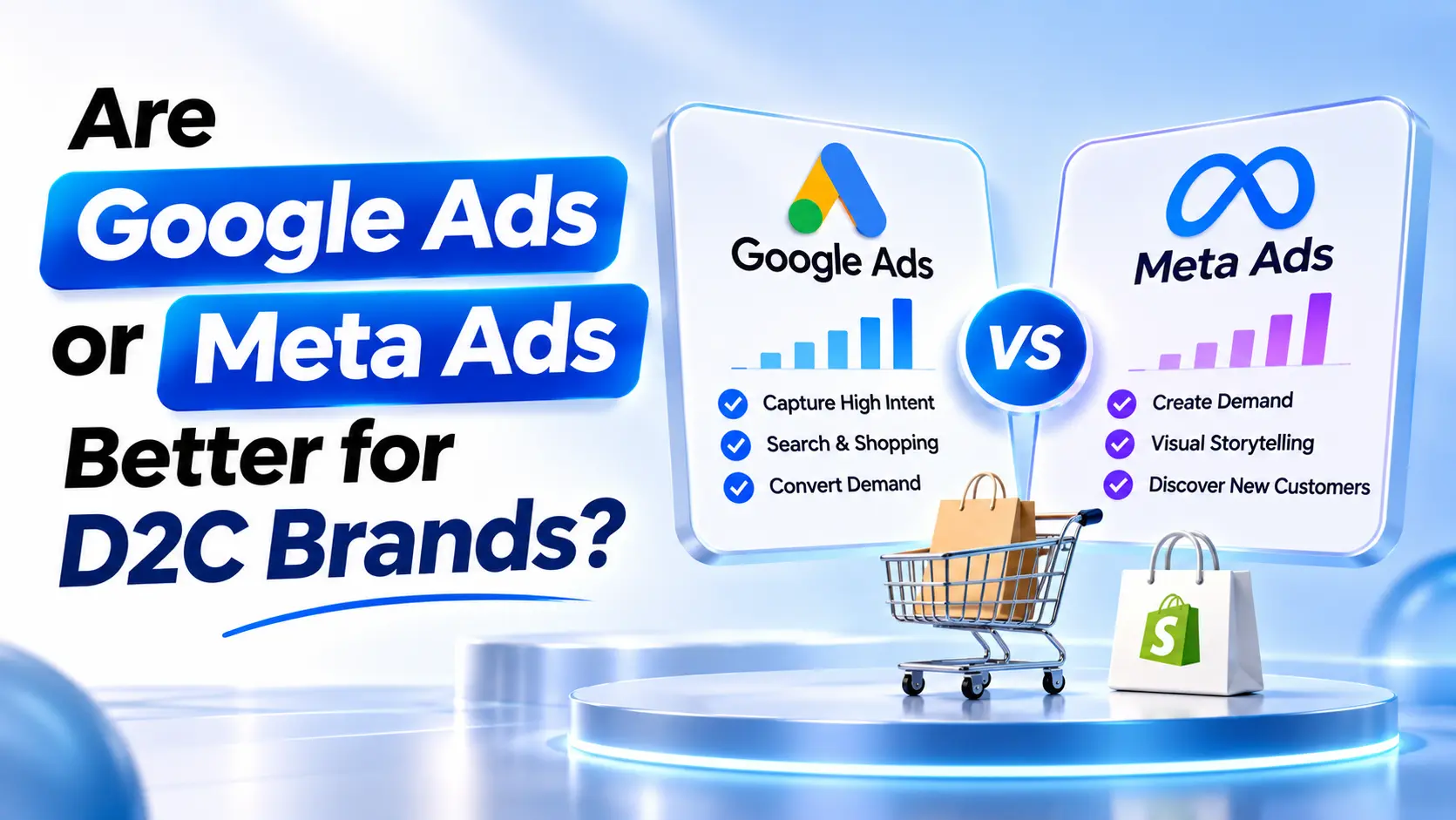
Google Ads vs Meta Ads is one of the most important decisions growing D2C brands face when planning their ecommerce marketing strategy.
You have a monthly advertising budget of ₹3 lakh. Should you invest most of it in Facebook and Instagram campaigns? Should you prioritize Google Search and Shopping Ads? Or should you split the investment between both platforms?
For many ecommerce founders, the answer seems straightforward: invest in whichever platform delivers the highest ROAS.
But that approach overlooks an important part of customer behaviour.
Google Ads often captures existing demand. Meta Ads often helps create demand.
Someone searching Google for “buy solid wood dining table” may already be considering a purchase.
Someone scrolling through Instagram might not be shopping for furniture at all, but a compelling product video could introduce them to a brand they eventually purchase from.
Both customers are valuable, but their journeys begin differently.
Understanding that difference can help D2C brands make smarter advertising decisions, reduce wasted spending, and build a stronger customer acquisition strategy.
Let’s explore which platform is better for your business in 2026.
Table of Contents
- Google Ads vs Meta Ads: Key differences
- How Google Ads works for D2C brands
- How Meta Ads works for ecommerce
- Which platform delivers better ROAS?
- Google Ads vs Meta Ads by industry
- How to split your advertising budget
- Seven strategies for better advertising performance
- When should you prioritize one platform?
- Final verdict
- Frequently asked questions
1. Google Ads vs Meta Ads: Understanding the Key Differences
Before comparing costs and performance, it’s important to understand what each platform is designed to achieve.
Google Ads allows brands to reach customers through search results, Shopping placements, YouTube, and other Google properties.
Meta Ads helps brands advertise across platforms including Facebook and Instagram, where people discover products through visual content and social experiences.
Here’s a practical comparison.
| Factor | Google Ads | Meta Ads |
|---|---|---|
| Primary Strength | Capturing existing intent | Creating and converting demand |
| Customer Behaviour | Searching or exploring | Scrolling, discovering, engaging |
| Key Formats | Search, Shopping, Video, Performance Max | Image, Video, Carousel, Catalog |
| Strong Use Cases | High-intent products, branded search, product comparisons | Product discovery, storytelling, creative testing |
| Creative Requirements | Product feeds, search copy, images and video | Strong visual concepts, videos and product storytelling |
| Scaling Limitation | Available search demand and channel efficiency | Audience response, creative performance and acquisition costs |
| Retargeting | Available | Available |
| Best Business Objective | Converting demand and expanding relevant reach | Discovering and acquiring potential customers |
These are general strengths, not rigid limitations. Modern Google campaigns can also create demand, while Meta campaigns can convert shoppers who already intend to buy.
Click400 Insight: The right advertising platform depends less on where your customers spend time and more on how they discover, evaluate, and purchase your products.
2. How Google Ads Works for D2C Brands
Google Ads can be especially valuable when customers actively search for your product category.
Imagine a customer searching:
“Best running shoes under ₹5,000”
“Premium leather office bags”
“Buy organic skincare online”
These searches can indicate existing product interest.
A relevant search advertisement or product listing can introduce your brand at the moment the customer is evaluating options.
Google Search Ads
Search Ads allow businesses to reach customers based on search queries.
They can be useful for product categories with clearly defined purchasing intent.
However, competitive keywords may be expensive, and not every search indicates immediate buying intent.
Google Shopping Ads
Shopping placements display product information such as images, prices, and merchant details.
They can help shoppers compare relevant products before visiting a store.
A well-maintained product feed, accurate pricing, and strong product information are important to effective Shopping campaigns.
Google Performance Max
Performance Max uses Google’s advertising inventory across Search, YouTube, Display, Discover, Gmail, and Maps through a unified campaign.
It’s designed to optimize toward specified conversion goals and can help ecommerce brands reach opportunities beyond traditional keyword-based Search campaigns.
When Google Ads Can Be a Strong Choice
Google Ads may deserve greater attention when your brand sells products that customers actively search for, when your products have clear search intent, or when branded and category searches generate qualified traffic.
However, high search volume doesn’t automatically guarantee profitable acquisition.
3. How Meta Ads Works for Ecommerce Brands
Meta Ads can help D2C businesses introduce products to people who may not yet be actively searching for them.
Think about a premium skincare brand launching a new serum.
Potential customers might not search for the product because they haven’t heard of it.
But an Instagram Reel demonstrating the product, explaining its benefits, and presenting its value could generate interest.
The customer discovers the product before developing an explicit search intention.
That’s a major strength of social advertising.
Creative-Led Product Discovery
Meta provides visual formats such as images, videos, carousels, and catalog advertisements.
These formats can help brands communicate their product benefits and brand identity.
For fashion, beauty, lifestyle, furniture, and accessories, strong visual storytelling can play an important role.
Meta Advantage+ Sales Campaigns
Meta’s Advantage+ sales solutions use automation to optimize advertising delivery toward sales objectives.
They can help brands evaluate broader acquisition opportunities, although campaign performance still depends on creative quality, tracking, product economics, and customer experience.
Catalog Advertising
Catalog advertisements allow ecommerce stores to promote relevant products using structured product data.
This can be useful for brands with multiple SKUs, collections, or product categories.
When Meta Ads Can Be a Strong Choice
Meta Ads may be particularly useful when your products benefit from demonstration, storytelling, lifestyle imagery, or visual discovery.
Click400 Insight: Meta Ads doesn’t always wait for customers to express demand. Effective creative can help customers recognize a need they hadn’t actively been searching for.
4. Google Ads vs Meta Ads: Which Delivers Better ROAS?
Return on Ad Spend (ROAS) measures attributed advertising revenue divided by advertising spend.
ROAS = Attributed Revenue ÷ Ad Spend
Suppose your brand invests ₹1 lakh in each platform.
| Metric | Google Ads | Meta Ads |
|---|---|---|
| Advertising Spend | ₹1,00,000 | ₹1,00,000 |
| Reported Attributed Revenue | ₹4,00,000 | ₹3,00,000 |
| Reported ROAS | 4X | 3X |
At first glance, Google Ads appears to be performing better.
But does that necessarily mean you should reduce your Meta budget?
Not always.
Imagine a customer discovers your brand through Instagram, visits your website, and decides to research alternatives.
Two days later, they search your brand name on Google and complete their purchase after clicking a search advertisement.
Depending on the attribution systems and reporting settings, both platforms may claim some credit for the purchase.
As a result, adding together platform-reported revenue may overstate the combined revenue actually generated.
What Should You Measure Instead?
Monitor these metrics together:
- Platform-reported ROAS
- Customer acquisition cost
- New customers acquired
- Shopify revenue and orders
- Average order value
- Contribution margin
- Blended marketing efficiency
For larger advertising budgets, controlled incrementality testing can help estimate whether campaigns are generating additional purchases rather than simply receiving credit for purchases that might have happened anyway.
A higher reported ROAS doesn’t automatically mean a platform contributes more incremental profit.
5. Google Ads vs Meta Ads: Which Is Better for Your D2C Industry?
Different product categories benefit from different customer acquisition strategies.
The following are practical starting hypotheses rather than verified industry performance benchmarks.
| D2C Industry | Google Ads Opportunity | Meta Ads Opportunity |
|---|---|---|
| Fashion & Apparel | Brand searches, product searches, Shopping | Lifestyle content, new collections, creator videos |
| Beauty & Skincare | Ingredient, concern and product searches | Demonstrations, testimonials, product education |
| Furniture & Home Decor | Category and high-intent product searches | Interior inspiration, lifestyle imagery, storytelling |
| Health & Wellness | Relevant product searches, where policy-eligible | Educational content, demonstrations, where policy-eligible |
| Jewellery & Accessories | Product-specific and occasion-based searches | Styling content, gifting campaigns, visual discovery |
| Food & Snacks | Product and branded searches | Product discovery, recipes, offers, video content |
Consider a premium furniture brand selling dining tables priced between ₹35,000 and ₹80,000.
Google Ads may help reach customers actively searching for solid wood furniture.
Meta Ads may help the brand communicate craftsmanship, aesthetics, customization, and lifestyle appeal.
Both platforms can support the purchase journey, but their roles may differ.
6. How Should a D2C Brand Split Its Google and Meta Ads Budget?
One common mistake is allocating 80–90% of the budget to whichever platform reported the best performance last month.
A better approach is to understand the role each platform plays in customer acquisition.
Example: ₹3 Lakh Monthly Advertising Budget
Here are three illustrative allocation models.
| Strategy | Meta Ads | Google Ads |
|---|---|---|
| Discovery-Led Brand | ₹2,10,000 (70%) | ₹90,000 (30%) |
| Balanced Acquisition | ₹1,50,000 (50%) | ₹1,50,000 (50%) |
| Search-Led Brand | ₹90,000 (30%) | ₹2,10,000 (70%) |
These are testing scenarios, not recommended industry averages.
A discovery-led strategy may fit visually appealing products that need customer education.
A search-led strategy may suit categories with significant existing purchasing demand.
A balanced approach may provide a useful starting point for a brand with limited channel performance history.
But before choosing a split, calculate your acceptable customer acquisition cost and break-even advertising return.
Your margin structure matters more than an arbitrary budget percentage.
For a broader breakdown, read our guide on How Much Should a D2C Brand Spend on Marketing?
7. Seven Smart Strategies to Improve Google Ads and Meta Ads Performance
Strategy 1: Define Each Platform’s Role
Avoid expecting every advertising campaign to achieve the same objective.
Use Google Search campaigns to evaluate existing demand and high-intent queries.
Use Meta campaigns to test product discovery, creative angles, and new audience acquisition.
Google’s Demand Gen and Performance Max campaigns can also support discovery, so platform roles should be based on actual performance rather than fixed assumptions.
Strategy 2: Prioritize New Customer Acquisition
High reported ROAS can sometimes be driven by existing customers or branded searches.
Track new and returning customers separately.
Compare acquisition costs and contribution margins to understand which campaigns are bringing genuinely valuable new customers.
Strategy 3: Improve Your Creative Strategy
Creative quality matters across both platforms.
For Meta Ads, test different product demonstrations, customer problems, founder stories, testimonials, and lifestyle concepts.
For Google, improve product feeds, search ad relevance, landing pages, images, and videos.
Different messages may resonate at different stages of the customer journey.
Strategy 4: Match Your Landing Page to the Advertisement
A customer searching for a specific product shouldn’t need to navigate through an unrelated homepage.
Likewise, someone clicking an Instagram advertisement promoting a particular collection should arrive at a page that reinforces the promise of that advertisement.
Landing page relevance can reduce unnecessary friction and help shoppers make decisions.
Strategy 5: Improve Your Shopify Conversion Rate
Advertising creates traffic, but your website influences what happens next.
Imagine 20,000 monthly ad-driven sessions with an average order value of ₹2,000.
At a 1.5% conversion rate, that’s approximately ₹6 lakh in gross revenue.
At a 2.5% conversion rate, the same traffic could generate ₹10 lakh.
This is a hypothetical example, not a guaranteed improvement.
It illustrates why investing in mobile usability, product presentation, and checkout experience can improve the economics of existing traffic.
For established ecommerce businesses, conversion-focused Shopify development can become an important part of their performance marketing strategy.
Strategy 6: Use Accurate Tracking and Measurement
Review Meta Pixel, Conversions API, Google Ads conversion tracking, and GA4 implementation.
Make sure purchase values, transaction identifiers, and relevant conversion events are being recorded correctly.
Avoid comparing platform dashboards without considering differences in attribution methods and reporting windows.
Use actual Shopify orders and financial performance as important reference points.
Strategy 7: Scale Based on Incremental Profitability
Increasing advertising budgets isn’t necessarily the same as increasing profitable growth.
Review marginal acquisition costs, incremental revenue, contribution margins, and operational capacity before expanding spend.
If additional advertising produces expensive customers or low-margin orders, improving efficiency may be more valuable than scaling.
8. When Should You Choose Google Ads Over Meta Ads?
Google Ads may deserve a larger share of investment when customers already search for products similar to yours, when your product catalogue is suitable for Shopping placements, or when relevant search demand consistently generates profitable new customers.
For example, a brand selling specialized office furniture may discover that product-specific searches generate high-quality enquiries and purchases.
In that situation, Google Ads could become a major acquisition channel.
However, search demand is finite, and increasing spend doesn’t necessarily generate proportionate additional conversions.
9. When Should You Choose Meta Ads Over Google Ads?
Meta Ads may deserve greater investment when your product is highly visual, when your brand needs to establish awareness, or when customer demand is strongly influenced by product discovery.
For example, a new premium jewellery brand may benefit from campaigns showing how its products look when worn, how they’re crafted, and what makes them distinctive.
This type of visual communication can introduce the brand to potential customers who weren’t actively searching for it.
However, creative-led discovery requires ongoing testing, strong product positioning, and an effective post-click experience.
10. The Real Opportunity: Making Google and Meta Work Together
For many established D2C brands, the best approach isn’t choosing one advertising platform.
It’s understanding how the two can complement each other.
Consider a customer journey:
Stage 1: Discovery
A customer sees your product in an Instagram Reel.
Stage 2: Research
They visit your website, explore the collection, and compare alternatives.
Stage 3: Purchase Intent
A few days later, they search for your brand or product category on Google.
Stage 4: Conversion
They click a relevant advertisement and complete a purchase.
Stage 5: Retention
Your brand continues the relationship through useful email, WhatsApp, or customer engagement campaigns.
The precise journey will vary, and not every shopper uses both platforms.
But it demonstrates why isolated channel optimization can overlook the bigger picture.
Click400 Insight: A strong D2C growth strategy doesn’t force Google and Meta to compete for credit. It measures how each platform helps the business acquire profitable customers.
Final Verdict: Google Ads or Meta Ads for D2C Brands?
So, which is better?
Google Ads is often a strong choice for capturing existing purchasing intent. Meta Ads is often a strong choice for driving product discovery and creating demand.
But neither platform is automatically more profitable for every ecommerce business.
For an established Shopify brand, the best advertising strategy should consider product category, customer behaviour, average order value, acquisition costs, conversion performance, and contribution margins.
Rather than asking which platform has the highest reported ROAS, ask:
Which advertising investment is bringing us additional profitable customers?
That question leads to better budget decisions and more sustainable growth.
At Click400 Technologies, we help growing D2C and ecommerce brands improve their digital growth through performance marketing, custom Shopify development, conversion-focused UI/UX design, and ecommerce optimization.
Because successful ecommerce growth isn’t only about generating more clicks.
It’s about connecting the right customers with a shopping experience that converts.
Explore our ecommerce solutions at Click400 Technologies.
Frequently Asked Questions
Is Google Ads better than Meta Ads for D2C brands?
Google Ads can be more effective for capturing existing purchasing intent, while Meta Ads can help create demand and introduce customers to new products. The best choice depends on your industry, customer behaviour, acquisition costs, and profitability.
Which gives better ROAS: Google Ads or Facebook Ads?
Neither platform guarantees higher ROAS. Results depend on campaign objectives, attribution settings, traffic quality, product economics, and website performance. Compare customer acquisition costs and actual business results alongside reported ROAS.
Should a new D2C brand start with Google Ads or Meta Ads?
A new brand with visually appealing products and limited existing search demand may consider starting with Meta Ads. A brand selling products with clear purchasing intent may consider Google Search or Shopping campaigns. A controlled test can help validate the choice.
How much should I spend on Google Ads and Meta Ads?
Set your advertising budget based on acceptable acquisition costs, margins, and growth objectives. Allocate spending according to relevant search demand, creative performance, and incremental profitability rather than using a universal percentage.
Can Google Ads and Meta Ads run together for a Shopify store?
Yes. Both platforms can support different stages of the customer journey. The important part is implementing reliable tracking, coordinating messages, and measuring the combined effect on customer acquisition and business performance.
Do Meta Ads work for premium D2C brands?
Yes. Meta Ads can help premium brands communicate product quality, craftsmanship, brand positioning, and visual appeal. However, campaign success also depends on reaching appropriate customers and maintaining a consistent premium shopping experience.
Does website design affect Google Ads and Meta Ads performance?
Yes. Product page quality, mobile usability, website performance, trust signals, and checkout friction can affect how effectively advertising traffic converts into purchases. Improving the customer journey may increase the commercial value of existing traffic.