


Blog
Why Is My Facebook Ads ROAS Dropping? 10 Reasons D2C Brands Should Know

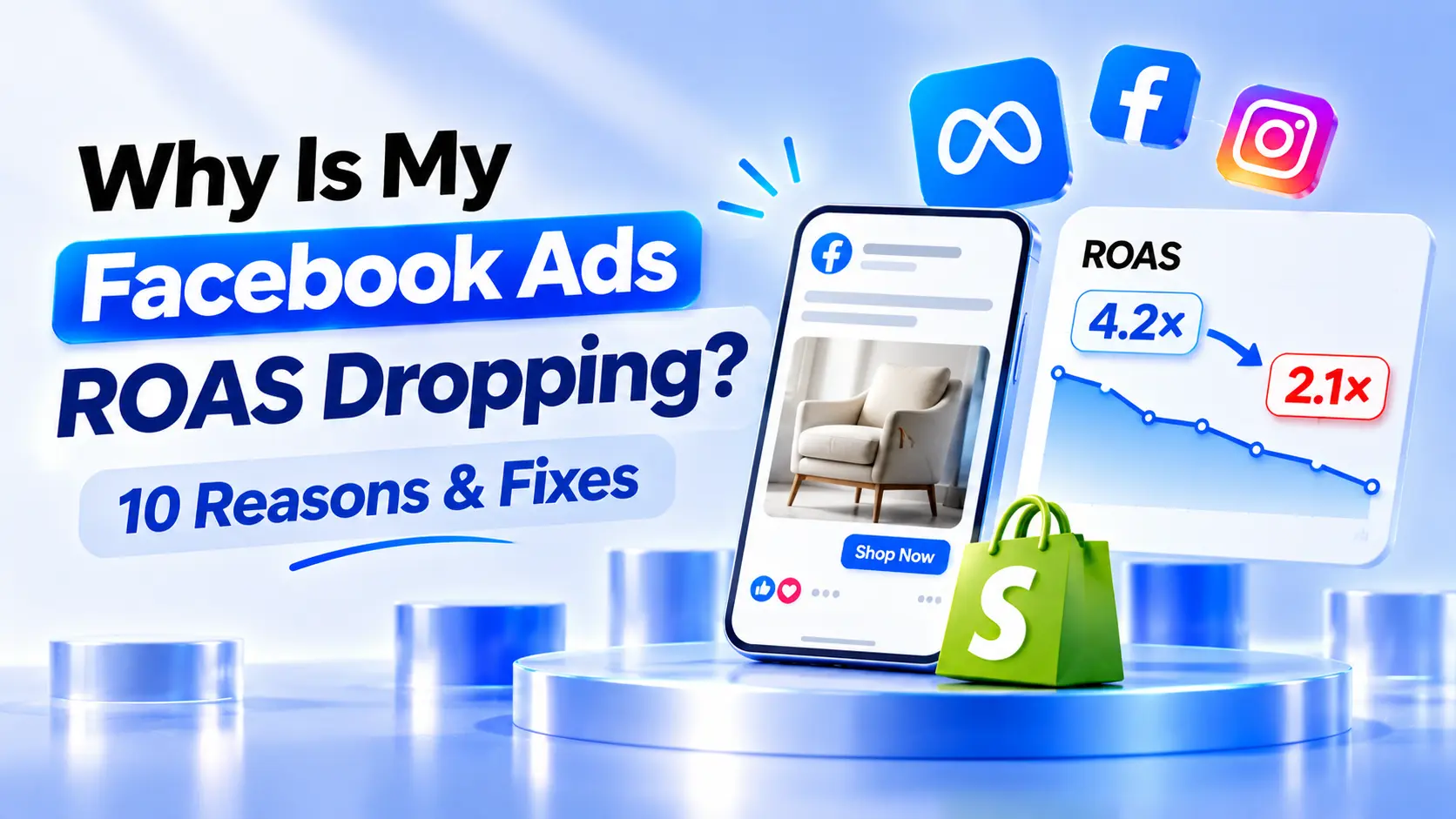
Your Facebook Ads were delivering a 4X ROAS a few months ago. Your campaigns were generating consistent orders, customer acquisition costs were manageable, and scaling seemed straightforward.
Now, you’re spending the same advertising budget, but your ROAS has dropped to 2X.
Your products haven’t changed. Your campaigns are still running. Your website continues receiving visitors.
So, what’s going wrong?
For many growing D2C brands, declining Facebook Ads ROAS is one of the most frustrating challenges in ecommerce marketing.
The immediate reaction is often to change targeting, increase budgets, launch new creatives, or blame Meta’s algorithm.
But here’s something important:
Your Facebook Ads ROAS might be dropping because of problems that have nothing to do with your ads.
Your website conversion rate, average order value, audience quality, attribution settings, and customer purchasing behavior can all affect advertising returns.
Before making another campaign adjustment, you need to identify what’s actually causing the decline.
Let’s explore the ten most common reasons your Meta Ads ROAS may be falling and what your brand can do about them.
First, Understand What ROAS Actually Measures
ROAS stands for Return on Ad Spend.
It measures how much attributed revenue your advertising generates compared with what you spend.
The formula is simple:
ROAS = Revenue Attributed to Ads ÷ Advertising Spend
For example, imagine your D2C brand spends ₹1,00,000 on Facebook Ads and generates ₹4,00,000 in attributed revenue.
Your ROAS is 4X.
Now suppose your advertising spend remains ₹1,00,000, but attributed revenue decreases to ₹2,00,000.
Your ROAS falls to 2X.
That’s a 50% reduction in reported advertising return.
However, ROAS doesn’t automatically tell you why performance declined.
The problem could be increasing traffic costs, fewer conversions, lower order values, or changes in how purchases are attributed.
Click400 Insight: ROAS is an outcome metric. To improve it, you need to understand the factors influencing that outcome.
1. Your Ad Creatives Are Losing Their Effectiveness
One of the first things to investigate when Meta Ads ROAS declines is creative fatigue.
An advertisement that performs well initially may become less effective after your audience has seen it repeatedly.
People begin ignoring familiar visuals, messages, and offers.
This can lead to lower engagement, higher acquisition costs, and declining returns.
But creative fatigue isn’t simply about how long an advertisement has been running.
An ad can continue performing profitably for months when it reaches new audiences and maintains relevance.
What to investigate:
- Click-through rate (CTR)
- Cost per thousand impressions (CPM)
- Frequency and audience reach
- Cost per purchase
- Creative fatigue or limited-delivery indicators
What to improve:
Introduce genuinely different creative concepts rather than constantly changing colours, headlines, or backgrounds.
Test product demonstrations, customer testimonials, problem-solution messaging, founder-led videos, and different product benefits.
The objective isn’t to produce more advertisements. It’s to discover which messages resonate with potential customers.
2. Your Customer Acquisition Costs Are Increasing
Your Facebook Ads ROAS may decline even when your website conversion rate stays relatively stable.
Why?
Because reaching potential customers can become more expensive.
Advertising competition, seasonal demand, audience saturation, and auction dynamics can increase CPM.
For example, consider a hypothetical campaign:
| Metric | Previous Period | Current Period |
|---|---|---|
| CPM | ₹200 | ₹300 |
| CTR | 2% | 2% |
| Cost Per Click | ₹10 | ₹15 |
| Website Conversion Rate | 2% | 2% |
| Cost Per Purchase | ₹500 | ₹750 |
In this simplified example, rising impression costs increase acquisition costs despite unchanged click-through and conversion rates.
What to improve:
Review CPM trends alongside CTR, cost per click, and cost per purchase.
If CPM is increasing, examine audience competition, campaign structure, creative relevance, and placement performance.
Increasing your advertising budget isn’t necessarily the right response to rising acquisition costs.
3. Your Website Conversion Rate Is Dropping
This is one of the most overlooked reasons for declining Facebook Ads ROAS.
Your advertising may still be bringing relevant visitors to your ecommerce store.
But what happens after someone clicks your advertisement?
Imagine your campaign generates 10,000 website sessions with an average order value of ₹2,000.
At a 2% conversion rate, those sessions generate approximately ₹4 lakh in revenue.
At a 1% conversion rate, revenue falls to ₹2 lakh.
You’ve lost half your revenue opportunity without reducing website traffic.
Possible reasons include slow-loading product pages, confusing navigation, poor mobile usability, missing trust signals, unclear shipping information, or checkout errors.
What to investigate:
Compare Shopify conversion rates, product add-to-cart activity, checkout initiation, and completed purchases before and after the ROAS decline.
Click400 Insight: If advertising traffic remains consistent but your website converts fewer visitors, continuously changing your Meta campaigns may not solve the underlying problem.
4. Your Ad Message Doesn’t Match Your Landing Page
Imagine a customer sees an Instagram advertisement promoting premium handcrafted furniture.
The ad highlights exceptional craftsmanship, natural materials, and luxury design.
But after clicking, the customer lands on a generic homepage filled with unrelated collections and discount banners.
The experience doesn’t match what attracted them.
This disconnect can reduce purchase intent.
The same problem occurs when an advertisement promotes one product, but users are directed to a broad collection page where they must search for it.
What to improve:
Ensure every campaign leads to a relevant product page, collection, or dedicated landing page.
Maintain consistency between your advertisement and website in product visuals, pricing, messaging, and offers.
For established D2C brands, improving the journey between an advertisement and a purchase can be as important as improving the advertisement itself.
5. You’re Making Too Many Changes to Your Meta Campaigns
When ROAS starts declining, advertisers often make frequent adjustments.
They change budgets, targeting, creatives, bid strategies, and campaign structures within a short period.
However, significant changes can cause Meta ad sets to re-enter the learning phase.
During learning, Meta’s delivery system is still identifying how best to deliver ads, so performance can be less stable.
Not every small change restarts learning. The significance depends on the type and scale of the edit.
What to improve:
Avoid making multiple major campaign changes simultaneously.
Document adjustments, allow appropriate evaluation periods, and compare performance using sufficient data.
Consolidating fragmented campaigns may also help when individual ad sets have too little conversion data to support reliable optimization.
The goal is to make controlled decisions rather than reacting to every daily fluctuation.
6. Your Audience Is Too Narrow or Repeatedly Exposed
Highly restrictive targeting can limit the number of potential customers your campaigns can reach.
When your audience is small, repeated exposure may become a problem, particularly if campaigns rely on a limited set of advertisements.
Audience overlap and excessive campaign segmentation can also complicate performance analysis.
However, broader targeting isn’t automatically better.
What matters is whether Meta is reaching people who are likely to become valuable customers.
What to improve:
Review audience reach, frequency, placement performance, and customer quality.
Test broader audience structures where appropriate, while using strong creative messaging and meaningful conversion signals to help attract relevant customers.
For premium D2C brands, the advertisement itself should communicate who the product is designed for.
7. Your Average Order Value Is Declining
A decrease in ROAS doesn’t always mean fewer customers are purchasing.
Sometimes your campaigns continue generating the same number of orders, but each order is worth less.
Consider this example:
Your campaign generates 200 orders at an average order value of ₹2,500.
Total attributed revenue: ₹5,00,000.
If AOV falls to ₹1,800, the same 200 orders generate ₹3,60,000.
With advertising spend unchanged, ROAS declines.
This may happen because customers purchase lower-priced products, discounting increases, or premium products sell less frequently.
What to improve:
Analyze average order value, product mix, promotional discounts, bundles, and cross-selling opportunities.
You may discover that improving basket value is a more effective growth opportunity than trying to reduce acquisition costs alone.
8. Your Tracking and Attribution Have Changed
Sometimes Facebook Ads ROAS appears to decline because of changes in measurement rather than a comparable decline in actual business performance.
Meta’s reporting uses attribution rules to determine which purchases receive credit from advertisements.
In March 2026, Meta updated how click-through and engage-through attribution are classified.
Conversions following actual advertisement link clicks are treated differently from conversions following other social interactions.
This means historical comparisons can become misleading if attribution settings or reporting definitions differ.
What to investigate:
- Meta Pixel and Conversions API implementation
- Purchase-event accuracy
- Event deduplication
- Attribution windows
- Shopify order and revenue trends
- Differences between Meta Ads Manager and other analytics platforms
Click400 Insight: Before concluding that your advertising performance has collapsed, determine whether actual orders have decreased or whether the platform is attributing fewer orders to your campaigns.
9. Your Product Offer Is Becoming Less Competitive
Even well-optimized Facebook Ads cannot completely compensate for an uncompetitive offer.
Your customers compare products, delivery promises, brand reputation, quality, pricing, and convenience.
A competitor may introduce a better bundle, improve product presentation, or offer a more convincing shopping experience.
As a result, potential customers may continue engaging with your ads but choose another brand when they’re ready to buy.
What to improve:
Review your value proposition and competitors’ customer experiences.
Focus on clearly communicating product differentiation, quality, customer benefits, delivery expectations, and post-purchase support.
For premium D2C brands, stronger differentiation can be more sustainable than aggressive discounting.
10. You’re Optimizing for ROAS Instead of Profitability
This is where many growing ecommerce brands make an expensive mistake.
They chase the highest possible ROAS without considering contribution margins, repeat purchases, or the long-term economics of customer acquisition.
Consider two hypothetical campaigns:
| Metric | Campaign A | Campaign B |
|---|---|---|
| Ad Spend | ₹1,00,000 | ₹1,00,000 |
| Attributed Revenue | ₹4,00,000 | ₹3,00,000 |
| ROAS | 4X | 3X |
| Contribution Margin Before Ads | 20% | 45% |
| Contribution After Ads | -₹20,000 | ₹35,000 |
In this illustration, Campaign A has a higher ROAS but produces a loss after advertising spend.
Campaign B has a lower ROAS but contributes positively.
The example assumes that contribution margin accounts for relevant variable costs before advertising and that attributed revenue is comparable across campaigns.
Click400 Insight: A high ROAS isn’t necessarily profitable, and a declining ROAS doesn’t automatically mean your ecommerce business is becoming less profitable.
How to Identify What’s Actually Causing Your ROAS to Drop
Rather than making random changes, use your advertising and ecommerce data to identify the most likely cause.
| Performance Pattern | Possible Issue | What to Check |
|---|---|---|
| CPM increases, CTR stable | Rising auction costs | Competition, audience, placements |
| CTR declines | Creative or message fatigue | Creative performance, reach, frequency |
| CPC stable, conversions decline | Website or audience-quality problem | Landing pages, Shopify conversion rate |
| Orders stable, ROAS falls | Lower order value | AOV, product mix, discounts |
| Meta ROAS falls, store revenue stable | Attribution or channel-mix change | Pixel, CAPI, attribution settings |
| ROAS falls after campaign edits | Learning instability | Change history, delivery status |
| ROAS falls across multiple campaigns | Broader demand or store issue | Seasonality, site errors, inventory |
These are diagnostic signals, not definitive explanations. Compare equivalent periods and examine multiple metrics before drawing conclusions.
What Is a Good Facebook Ads ROAS for D2C Brands?
There’s no universal ROAS target that works for every ecommerce business.
A skincare brand with healthy repeat purchase rates may be able to acquire customers at a lower first-purchase ROAS.
A furniture brand with higher order values and infrequent repeat purchases may need a different acquisition strategy.
Your break-even ROAS depends on your contribution margin.
Break-even ROAS = 1 ÷ Contribution Margin Before Advertising
For example:
| Contribution Margin | Break-even ROAS |
|---|---|
| 20% | 5.0X |
| 25% | 4.0X |
| 40% | 2.5X |
| 50% | 2.0X |
| 60% | 1.67X |
These figures assume comparable attributed revenue and exclude fixed overheads. Your real profitability target should also account for refunds, returns, payment fees, and other relevant expenses.
Instead of blindly targeting 4X or 5X, calculate the ROAS your business actually needs.
What Should You Fix First When Facebook Ads ROAS Drops?
Start by investigating the entire customer journey, not just your campaign dashboard.
Step 1: Verify the decline. Compare similar reporting periods, account for attribution settings, and confirm actual Shopify sales trends.
Step 2: Identify the changing metric. Determine whether the decline is driven by CPM, CTR, cost per click, website conversion rate, or average order value.
Step 3: Check your ecommerce store. Review product pages, mobile performance, inventory, payment failures, and checkout completion.
Step 4: Audit your creative strategy. Identify which messages, formats, and product benefits still attract qualified shoppers.
Step 5: Test controlled improvements. Make focused changes, monitor results, and avoid changing every campaign variable at once.
The most effective solution depends on where performance is deteriorating.
Final Thoughts: Your Facebook Ads Might Not Be the Real Problem
When Meta Ads ROAS declines, it’s easy to assume the advertising platform is responsible.
Sometimes it is.
But declining returns may also reveal deeper problems with your website, product positioning, customer experience, or business economics.
A great advertising campaign creates an opportunity for a customer to discover your brand.
Your ecommerce website must then help turn that opportunity into a purchase.
For established D2C brands, improving advertising performance often requires looking beyond advertising itself.
At Click400 Technologies, we help growing Shopify and ecommerce brands improve their digital shopping experiences through custom Shopify development, conversion-focused UI/UX design, and performance optimization.
Because improving ROAS isn’t always about generating more clicks.
Sometimes, it’s about making every existing click work harder.
Explore our ecommerce solutions at Click400 Technologies.
Frequently Asked Questions
Why is my Facebook Ads ROAS suddenly dropping?
Sudden ROAS declines can result from rising advertising costs, creative fatigue, website conversion issues, lower average order value, changes in attribution, or campaign adjustments. Examine the underlying metrics before changing your strategy.
Is 2X ROAS good for Facebook Ads?
A 2X ROAS means ₹2 in attributed revenue for every ₹1 spent on advertising. Whether it’s profitable depends on your margins, fulfilment costs, returns, and customer lifetime value. A 2X ROAS can be profitable for some businesses and unprofitable for others.
Does increasing the Facebook Ads budget reduce ROAS?
It can. Increasing budgets may expand delivery to additional audiences and change acquisition costs. However, declining ROAS isn’t an inevitable consequence of scaling. Monitor marginal performance when increasing spend.
Can a Shopify website affect Facebook Ads ROAS?
Yes. If Facebook Ads generate qualified visitors but the website fails to convert them, campaign ROAS can decline. Product pages, mobile usability, website speed, payment options, and checkout experience all influence purchasing outcomes.
How can I improve Meta Ads ROAS without spending more?
Focus on creative relevance, qualified traffic, landing page consistency, website conversion optimization, average order value, and accurate measurement. Improve the areas supported by your data rather than applying every tactic at once.
Why does Meta Ads show a different ROAS than Shopify?
Meta and Shopify can use different attribution models, reporting windows, and measurement methods. A purchase may be credited differently across platforms. Compare actual orders, revenue, attribution settings, and tracking implementation before interpreting the difference.