


Blog
7 Best International Payment Gateways for D2C Brands in India (2026)

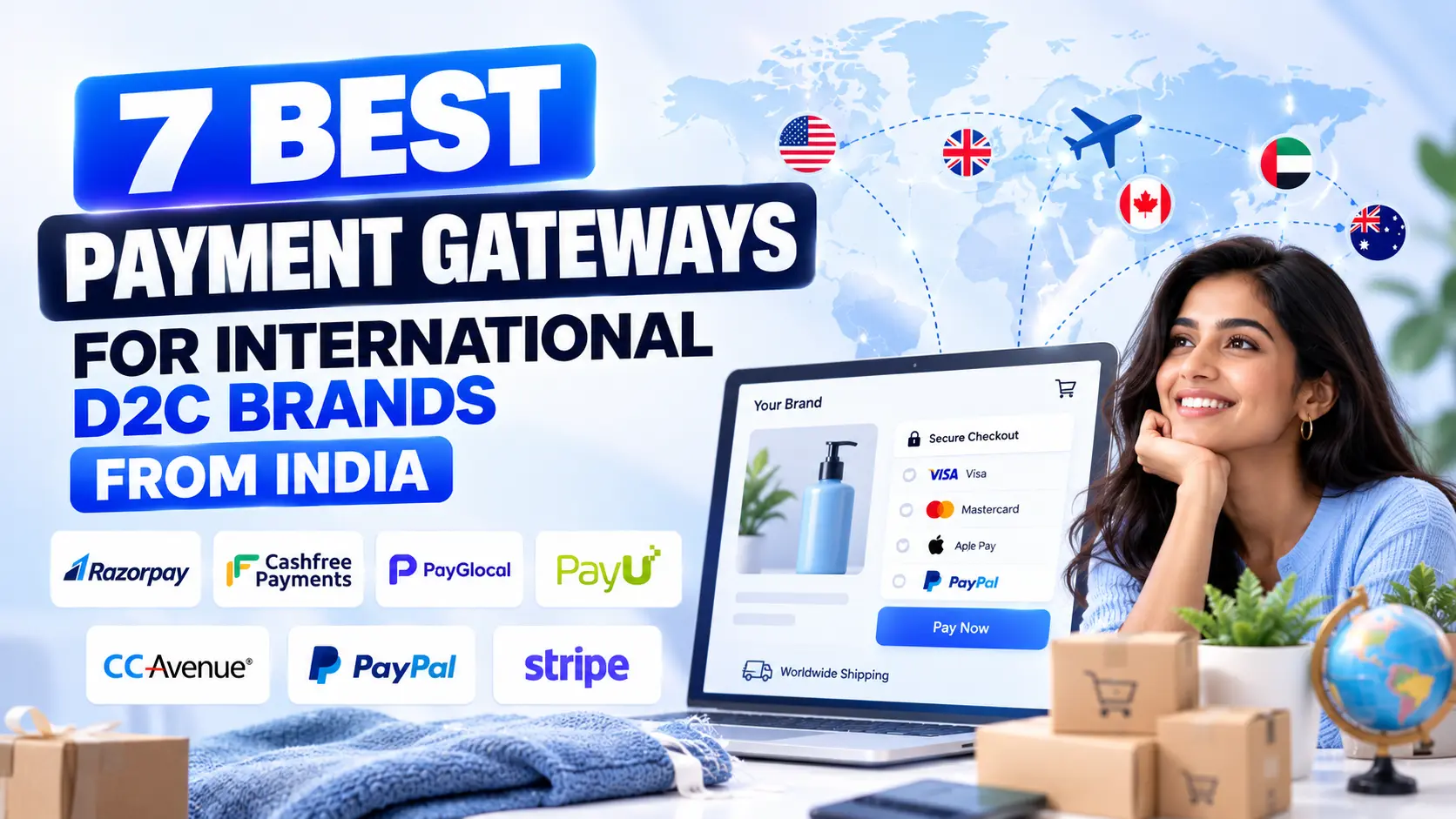
Selling internationally is an exciting opportunity for Indian D2C brands. Whether you’re running a fashion label, skincare brand, jewelry business, or home decor store, reaching customers in the USA, UK, UAE, Canada, and Australia can open up new revenue opportunities.
But getting international customers to your website is only half the challenge. You also need to make sure they can pay you easily.
Imagine a customer in the United States finds your product, adds it to their cart, and proceeds to checkout. Everything looks perfect until their credit card gets declined.
You’ve just lost a potential international sale.
This is why choosing the best international payment gateway for D2C brands in India is so important.
The right payment gateway helps your customers complete their purchases securely, supports international payment methods, and simplifies the process of receiving money in your Indian bank account.
In this guide, we’ll compare seven international payment gateways for Indian D2C businesses, explore their features and charges, and help you decide which one makes sense for your online store.
What Is an International Payment Gateway?
An international payment gateway is a payment solution that allows your online business to accept payments from customers located in other countries.
Unlike a regular domestic payment gateway, an international gateway is designed to handle foreign-issued cards, cross-border transactions, currency conversion, and overseas payment processing.
For example, if you own a jewelry brand in Jaipur and sell a gemstone necklace to a customer in London, an international payment gateway can help you accept the customer’s payment and receive the settlement through your Indian banking arrangement.
Depending on the provider and your website platform, international gateways may offer:
- International credit and debit card acceptance
- Multiple currency support
- Digital wallets such as Apple Pay and PayPal
- Currency conversion and INR settlements
- Fraud protection and chargeback management
- International transaction reporting and export documentation
Important: Supporting international cards doesn’t automatically mean your website can charge customers in their local currencies. Actual checkout currency support depends on both your gateway and eCommerce platform.
Why Do Indian D2C Brands Need a Reliable International Payment Gateway?
When you’re selling to customers outside India, your checkout experience becomes an important part of your international growth strategy.
A reliable international payment gateway can help your business in several ways.
1. Reduce Payment Failures
International payments can fail because of bank restrictions, authentication issues, fraud filters, or unsupported payment methods.
Choosing a gateway with effective international acquiring and transaction routing can help improve payment approval rates.
2. Build Customer Trust
International customers prefer payment methods they recognize. Offering familiar cards and eligible digital wallets can make checkout more comfortable.
3. Simplify International Settlements
A suitable gateway can convert foreign-currency payments and settle the proceeds into your Indian business bank account.
This reduces the operational complexity of receiving international payments.
4. Support Business Growth
As your brand expands into new markets, you need a payment setup that can support increasing transaction volumes, customer locations, refunds, and payment disputes.
A gateway that works well for your current business and future expansion can save considerable time and effort.
7 Best International Payment Gateways for D2C Brands in India
Here are seven payment gateways worth evaluating if you’re planning to sell products internationally from India.
1. Razorpay – Best for Indian D2C Brands Seeking an All-in-One Payment Solution
Razorpay is a popular payment platform among Indian online businesses.
Alongside its domestic payment solutions, Razorpay offers international payment acceptance for eligible businesses selling products and services to customers abroad.
This makes it worth considering for brands that want to manage domestic and international payment collections through a familiar platform.
Key Features
- Accept international credit and debit cards
- Support for multiple international currencies
- Payment links and online payment gateway solutions
- International payment reporting
- Fraud and dispute management tools
- eCommerce integration options
Razorpay currently advertises international card pricing of up to 3% per transaction, subject to applicable terms and eligibility.
Best For: Indian D2C businesses that already use Razorpay or want to explore an integrated domestic and international payment solution.
Things to Consider: International payments may require separate activation and business verification. Confirm the supported countries, actual checkout currencies, applicable FX charges, and settlement terms before choosing it.
2. Cashfree Payments – Best for Brands Looking for International Payments With INR Settlements
Cashfree Payments is another strong option for Indian D2C businesses selling internationally.
Its international payment gateway supports payments from overseas customers through international cards and other eligible payment methods.
Cashfree advertises collection across more than 170 countries and support for over 140 currencies, with payments settled into Indian bank accounts in INR.
Key Features
- International card acceptance
- Support for 140+ currencies
- Apple Pay and PayPal payment options, subject to eligibility
- Local bank-transfer collection solutions
- Foreign inward remittance reporting
- Fraud prevention and payment authentication tools
Cashfree publishes a standard international card transaction rate of 2.99%. Promotional or negotiated rates may differ.
Best For: Growing Indian D2C brands looking for a payment solution that combines international collections, INR settlement, and transaction documentation.
Things to Consider: Confirm which international payment methods are available to your account and whether your specific Shopify, WooCommerce, or custom website integration supports them.
3. PayGlocal – Best for Cross-Border-Focused D2C Brands
PayGlocal focuses specifically on cross-border payment infrastructure.
This makes it an interesting option for Indian businesses that generate a significant portion of their revenue from international customers.
Its platform offers international card payments, alternate payment methods, fraud management, and payment-routing tools designed for cross-border transactions.
Key Features
- International card acceptance
- Support for multiple foreign currencies
- Intelligent payment routing
- Localized checkout capabilities
- International fraud and risk management
- Shopify, WooCommerce, and Magento integrations
- Cross-border payment documentation and reporting
PayGlocal also offers multi-currency collection accounts for businesses receiving eligible international bank transfers.
Best For: Established or fast-growing D2C brands focusing heavily on international sales and payment conversion optimization.
Things to Consider: Ask for merchant-specific pricing, international transaction approval data, and supported payment methods in your target countries.
Provider-advertised success rates should be treated as marketing benchmarks rather than guaranteed performance for your store.
4. PayU – Best for Brands Expanding Across Multiple International Markets
PayU provides international payment solutions for Indian businesses selling to customers overseas.
Its international payment offering supports major international card networks and multiple currencies, making it an option for businesses targeting markets such as the USA, Europe, UAE, and Australia.
Key Features
- International Visa, Mastercard, and American Express acceptance
- Support for 135+ currencies
- Local currency presentation options
- INR settlements
- International fraud monitoring
- Payment processing and reporting tools
PayU states that international payments typically settle in INR within T+2 business days, although the actual arrangement depends on the merchant and transaction.
Best For: D2C brands looking to expand into multiple countries and manage domestic and international payment acceptance.
Things to Consider: International acceptance must be enabled for your merchant account. Contact PayU to confirm international pricing, integration compatibility, and supported markets.
5. CCAvenue – Best for Brands Looking for Multiple Currency Processing Options
CCAvenue is an established payment gateway provider offering domestic and international online payment solutions.
One of its features is multiple currency processing, which allows eligible merchants to collect international payments in supported foreign currencies.
CCAvenue currently lists 27 major foreign currencies in its international payment offering.
Key Features
- International payment acceptance
- Multiple currency processing
- Credit and debit card payments
- Multilingual checkout options
- Fraud prevention tools
- eCommerce payment integrations
Best For: Indian D2C businesses that want to evaluate an established gateway with international currency processing capabilities.
Things to Consider: Confirm activation requirements, transaction fees, foreign exchange costs, settlement timelines, and compatibility with your specific website platform.
6. PayPal – Best as an Additional Payment Option for International Customers
PayPal is a globally recognized online payment platform.
For Indian D2C brands, PayPal can be a useful additional checkout option because international customers may already have PayPal accounts.
For example, a customer in the USA might prefer paying with PayPal rather than entering their card details into an unfamiliar website.
Offering this alternative may help remove checkout friction for some shoppers.
Key Features
- International online payment acceptance
- Familiar payment experience for overseas customers
- Payments in multiple foreign currencies
- Buyer and seller protection programs, subject to eligibility
- International merchant reporting
However, PayPal can be relatively expensive compared with some card-processing alternatives.
According to PayPal India’s published merchant fee schedule, its standard fee for receiving an international commercial transaction is 4.40% plus a fixed fee, with currency conversion charges potentially applying separately.
Another important limitation is that Indian PayPal accounts cannot receive domestic customer payments.
Best For: Indian D2C brands that want to offer an additional, internationally recognized payment option alongside their primary gateway.
Things to Consider: Review the total transaction cost, currency conversion fees, dispute policies, and your website’s integration support.
7. Stripe – Best for Eligible Businesses Needing Advanced Payment Infrastructure
Stripe is a well-known payment infrastructure provider with extensive developer tools and international payment capabilities.
It offers APIs, payment processing tools, and other infrastructure that can support complex international commerce requirements.
However, there’s an important limitation for Indian merchants.
Stripe currently operates on an invitation-only basis for new accounts in India.
Indian businesses cannot freely create a new Stripe account through its standard online signup process.
Existing Stripe India merchants can continue using supported services, while new businesses must request an invitation.
Key Features
- International card payment processing
- Support for 135+ foreign currencies for eligible India accounts
- APIs and developer integrations
- Fraud prevention tools
- Payment reporting and analytics
- Advanced payment integration capabilities
Best For: Eligible Indian businesses with access to Stripe that need flexible payment infrastructure for international operations.
Things to Consider: Stripe should not be treated as a guaranteed onboarding option for a newly launched Indian D2C store. Confirm eligibility before building your payment strategy around it.
International Payment Gateways in India: Quick Comparison
| Payment Gateway | Best For | International Payment Support | Pricing |
|---|---|---|---|
| Razorpay | Indian D2C stores seeking an all-in-one solution | Global cards and other eligible methods | Advertised up to 3% for international cards* |
| Cashfree | Growing D2C and export businesses | Global cards, wallets and collections | Standard 2.99% for international cards* |
| PayGlocal | Cross-border-focused D2C brands | Global cards and alternate methods | Request a quote |
| PayU | Multi-market expansion | Global cards and multiple currencies | Request a quote |
| CCAvenue | Multiple currency processing | International cards and supported currencies | Depends on merchant plan |
| PayPal | Additional trusted checkout option | International payments | 4.40% + fixed fee* |
| Stripe | Eligible businesses needing advanced integrations | Global payments | Confirm account eligibility and applicable rates |
Published or advertised rates are indicative and may exclude taxes, FX conversion, chargebacks, refunds, or other applicable charges. Always verify current merchant-specific pricing.
Which Payment Gateway Is Best for Indian Shopify D2C Brands?
If you’re running your international D2C store on Shopify, selecting the right payment gateway requires some additional attention.
First, Shopify Payments is not currently available to businesses based in India. Indian Shopify merchants generally need to use an eligible third-party payment provider.
Providers such as Razorpay, Cashfree, PayU, PayGlocal, and PayPal may be worth evaluating based on their current Shopify integration and merchant eligibility.
However, two details are particularly important.
International Cards and Multi-Currency Checkout Are Different
A payment gateway may support foreign-issued credit cards even when your Shopify checkout charges customers in your store’s default currency.
According to Shopify’s payment documentation, native checkout processing in customers’ local currencies generally requires Shopify Payments or Adyen.
With other third-party providers, local currency prices displayed on your storefront may be converted back to your store’s default currency at checkout.
For Indian Shopify merchants, this distinction can affect the international buying experience.
Third-Party Transaction Fees Matter
Shopify may charge additional third-party transaction fees when you use external payment providers.
These fees can apply on top of the charges collected by your payment gateway.
For example, you should evaluate the combined cost of gateway processing, currency conversion, Shopify transaction fees, and any applicable taxes rather than comparing gateway percentages alone.
Before activating an international payment gateway on Shopify, test the complete checkout experience for customers in your target countries.
How to Choose the Best International Payment Gateway for Your D2C Business
There isn’t one payment gateway that’s best for every Indian D2C brand.
The right option depends on your target customers, eCommerce platform, transaction volume, and business model.
Here are the most important factors to compare.
1. International Payment Success Rate
A low transaction fee is attractive, but it means little if a large number of customers experience declined payments.
Ask shortlisted providers for relevant transaction approval information covering your target countries, supported card networks, and business category.
2. Total International Transaction Charges
International payment costs can include:
- Payment gateway processing fees
- Foreign exchange conversion charges
- Platform transaction fees
- Refund and chargeback fees
- Applicable taxes
The cheapest advertised processing rate isn’t always the lowest overall cost.
3. Target Country and Currency Support
If most of your orders come from the USA, UK, UAE, and Canada, prioritize a gateway that performs well in those markets.
Check card acceptance, payment methods, actual checkout currency, and settlement support.
4. Settlement Time and Currency Conversion
Understand how long international settlements take, which exchange rate is used, and whether additional conversion charges apply.
Predictable settlements are especially important when you need cash flow for production, marketing, inventory, and international shipping.
5. eCommerce Platform Integration
Your gateway must work reliably with your website.
If you use Shopify, WooCommerce, Magento, or a custom-built store, verify the provider’s supported integration and actual international checkout features.
6. Fraud Prevention and Chargeback Support
International disputes can be expensive.
Look for payment authentication, fraud monitoring, transparent chargeback procedures, and accessible merchant support.
Documents Required to Accept International Payments in India
Before activating an international payment gateway, Indian businesses generally need to complete merchant verification and meet applicable export requirements.
Depending on the provider and business type, you may need:
- PAN and business KYC documents
- Business registration information
- Indian business bank account details
- GST registration details, where applicable
- Importer Exporter Code (IEC), where required
- Website URL and product information
- Refund, shipping, privacy, and terms policies
- Applicable RBI purpose code and export details
Businesses exporting physical goods should pay particular attention to IEC requirements, export records, customs documentation, and foreign inward remittance evidence.
Providers may issue Foreign Inward Remittance Advice (FIRA), Foreign Inward Remittance Certificates (FIRC), or other applicable settlement statements depending on the payment arrangement.
Because regulatory and tax requirements vary, discuss your export setup with your bank or a qualified tax adviser.
Common Mistakes Indian D2C Brands Make When Choosing an International Gateway
Choosing only based on fees: A slightly cheaper gateway may not be worthwhile if more payments fail.
Ignoring checkout currency: Displaying product prices in USD doesn’t automatically mean the customer will be charged in USD.
Not checking Shopify compatibility: A provider’s standalone payment capabilities may not all be available inside Shopify checkout.
Relying on only one payment method: Supporting appropriate alternative payment options can make your checkout more accessible.
Ignoring settlement documentation: International payments need proper reporting and reconciliation, especially for exporting businesses.
Skipping real-world checkout testing: Test transactions and refunds across your main customer markets before launching large international advertising campaigns.
Our Recommendation: Which International Payment Gateway Should You Choose?
For a newly launched Indian D2C brand, Cashfree and Razorpay are sensible starting points because both offer established payment infrastructure and international payment products.
For a brand focused primarily on selling internationally, PayGlocal deserves a closer look because its products emphasize cross-border payment acceptance, routing, and international checkout performance.
PayU and CCAvenue are also worth comparing, particularly when evaluating multiple currencies or different acquiring arrangements.
PayPal can be useful as an additional payment option for customers who prefer it, although its overall cost should be considered.
Stripe remains a potential solution for eligible businesses, but its invitation-only onboarding in India limits its accessibility for new merchants.
Ultimately, the right decision should be based on your own store’s performance, not just advertised features.
Shortlist two or three providers, request complete pricing, confirm integration compatibility, and compare real transaction approval rates wherever possible.
Frequently Asked Questions
1. Which is the best international payment gateway for D2C brands in India?
Razorpay, Cashfree, and PayGlocal are among the options worth evaluating. The best choice depends on your target markets, website platform, international transaction volume, and total processing costs.
2. Can Indian D2C brands accept payments in USD?
Yes. Eligible Indian businesses can accept payments from international customers using supported payment gateways. However, whether customers are actually charged in USD depends on the gateway, payment integration, and eCommerce platform.
3. Which payment gateway is best for Shopify international payments in India?
Cashfree, Razorpay, PayGlocal, and other supported Shopify payment providers are worth considering. Verify current gateway availability, international card activation, and actual checkout currency support before choosing.
4. Can I use Stripe for my Indian D2C brand?
Stripe is currently invitation-only for new accounts based in India. Businesses must request access, and approval is not guaranteed.
5. Is PayPal good for international D2C payments?
PayPal can be a useful additional international checkout option, especially for customers familiar with the platform. However, Indian merchants should compare its processing and conversion charges with other gateways.
6. Do I need an IEC to receive international payments in India?
Businesses exporting physical goods generally require an Importer Exporter Code, subject to applicable e