


Blog
Third-Party Shopify Themes vs Official Shopify Paid Themes: Which Is Better for Your Store’s Long-Term Growth?

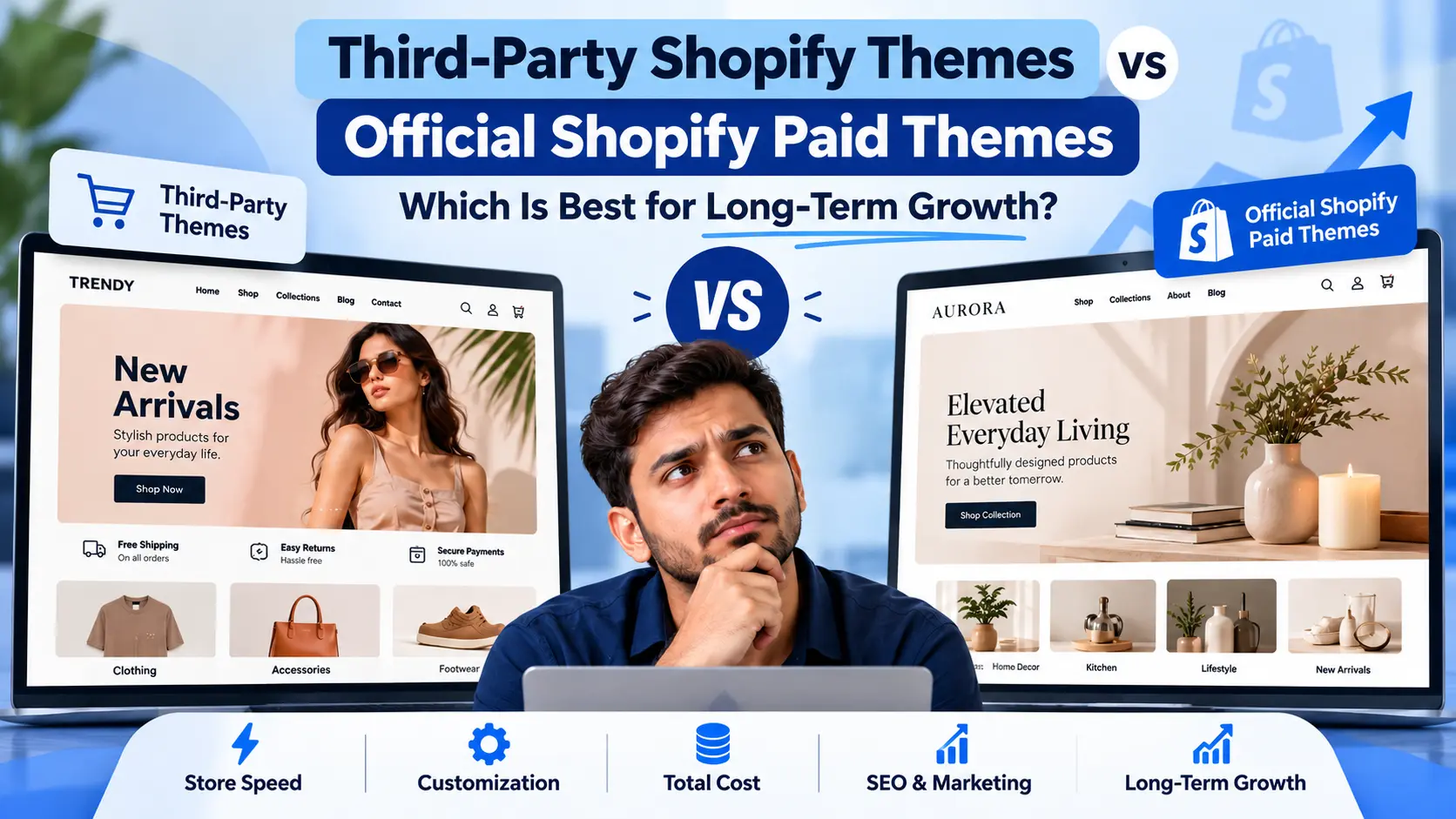
You’ve launched your Shopify store, uploaded your products, and started investing in marketing. Now you’re thinking about improving your website design or switching to a more professional Shopify theme.
You open the Shopify Theme Store and find premium themes with polished layouts and useful eCommerce features.
Then you discover third-party marketplaces offering Shopify themes at much lower prices, sometimes with dozens of additional features.
Naturally, you start wondering:
Why should I spend more on an official Shopify paid theme when a cheaper third-party theme offers almost everything I need?
It’s a reasonable question, especially when you’re running a growing D2C business and every investment needs to deliver value.
But here’s something many Shopify merchants discover only after their store starts growing:
The theme you choose today can either make your future growth easier or create expensive limitations later.
Let’s understand the differences between third-party Shopify themes and official Shopify paid themes, and which option makes more sense for your business.
1. Your Shopify Theme Is More Than Just Your Store’s Design
When you’re launching your first Shopify store, choosing a theme usually comes down to three things:
- Does the website look premium?
- Does it have the features I need?
- Is the price within my budget?
And that’s perfectly understandable.
But imagine your business six months from now.
Your monthly orders are increasing. You’re spending more on Meta and Google Ads. You’re adding new collections, running seasonal campaigns, and experimenting with landing pages.
Suddenly, you need your website to do much more than simply display products.
You need faster product pages, better mobile navigation, custom product sections, upselling opportunities, and a checkout journey that converts visitors into customers.
This is when your Shopify theme becomes a business decision rather than just a design decision.
A good theme should help your business grow without requiring expensive development work every time you want to make an improvement.
2. Why Do So Many Shopify Merchants Choose Third-Party Themes?
Let’s say you’re launching a fashion, beauty, home decor, or lifestyle brand.
You explore a third-party theme marketplace and discover a theme offering:
- Multiple homepage layouts
- Product sliders and promotional banners
- Advanced product filtering
- Countdown timers and promotional features
- Quick-view product functionality
- Pre-designed collection and product pages
And the price looks attractive.
Compared with a premium theme from Shopify’s official Theme Store, it might seem like a much better deal.
For a new merchant, that’s a compelling proposition.
But here’s what you should check before buying
Not every third-party theme is poorly developed. Some are excellent.
The challenge is that themes purchased outside Shopify’s official marketplace don’t necessarily go through the same review process as themes listed in the Shopify Theme Store.
You need to evaluate the developer’s reliability, update history, documentation, and technical quality yourself.
Imagine purchasing a theme because it includes 50 different features, but your store actually uses only 12 of them.
If the remaining functionality adds unnecessary scripts or complexity, you may end up maintaining features that contribute very little to your revenue.
Merchant takeaway: Don’t choose a Shopify theme based on how many features it advertises. Choose it based on how effectively those features support your customers’ shopping experience.
3. Why Are Official Shopify Paid Themes Usually a Safer Long-Term Choice?
Official Shopify paid themes are premium themes available through the Shopify Theme Store.
They may be developed by Shopify or independent theme developers, but they must meet Shopify’s Theme Store requirements.
For a merchant planning to build a serious D2C brand, this provides a more predictable technical foundation.
Consider a simple example.
You’re running a skincare brand with 40 products.
Today, you need an attractive homepage, collection pages, product reviews, and a smooth mobile shopping experience.
Next year, you might expand to 200 products, introduce product bundles, create personalized landing pages, and integrate new marketing applications.
Your website needs to evolve alongside your business.
A well-maintained official Shopify paid theme can make that process easier because it follows Shopify’s supported theme architecture and update ecosystem.
However, remember that buying a premium theme does not automatically guarantee better speed, higher conversions, or unlimited customization.
Your actual results will still depend on how well the store is designed, configured, and maintained.
4. Your Store Speed Matters More Than the Theme Demo
Here’s a situation many merchants can relate to.
You purchase a theme after viewing its beautiful demo.
The animations are smooth, the product images look amazing, and every section appears perfectly designed.
But once you install it on your own store, things start changing.
You add a reviews app, WhatsApp chat, a tracking pixel, a shipping integration, a product recommendation tool, and a few marketing applications.
Now your mobile product pages feel slower.
Your advertising campaigns are sending traffic to a store that isn’t delivering the shopping experience you expected.
Why does this happen?
Your Shopify theme is only one part of your store’s performance.
Image sizes, custom scripts, third-party applications, and design choices all affect how quickly customers can browse your website.
Some external themes also include large feature bundles that may add unnecessary complexity.
Official Shopify Theme Store themes must meet technical performance requirements, but they can still become slow when poorly configured.
What should you do as a merchant?
Before purchasing any theme, test its demo on a mobile device.
Look at how quickly the product page loads, how smoothly variants can be selected, and whether the add-to-cart button responds without delay.
Use Google PageSpeed Insights to compare performance, but don’t rely on a single score.
The goal isn’t to own the theme with the highest demo speed score. The goal is to create a fast shopping experience for your actual customers.
5. What Happens When You Want to Customize Your Store?
This is where the long-term difference becomes more noticeable.
Imagine you’re running a premium furniture brand.
Initially, a standard product page works well.
But as your business grows, you want to display wood finishes, fabric options, detailed dimensions, delivery information, customization requests, and lifestyle imagery.
Your standard theme layout may no longer be enough.
You contact your Shopify developer and ask for a customized product page.
Now the real question becomes:
How easy is it for your developer to modify your existing theme without creating future problems?
A well-structured theme allows developers to build reusable sections, custom templates, and flexible product experiences.
A poorly structured theme can make even relatively simple modifications expensive.
Official paid theme vs external third-party theme
An official Shopify paid theme is often a dependable starting point for custom development because it must satisfy Shopify’s technical requirements.
An external theme can be equally customizable if its developer has followed sound engineering practices.
But if the code is difficult to maintain or poorly documented, every new feature can require additional development effort.
For a growing merchant, these expenses add up.
Merchant takeaway: If you plan to invest in custom UI/UX, choose a theme based on code quality and maintainability, not just appearance.
6. The Hidden Cost of a Cheaper Shopify Theme
Let’s look at a practical business scenario.
You’re comparing two Shopify themes.
One is an external theme priced at ₹5,000.
The other is an official paid theme priced at ₹30,000.
At first glance, choosing the ₹5,000 theme seems like an obvious way to save ₹25,000.
But imagine what happens over the next two years.
Your cheaper theme requires additional development to fix compatibility issues, modify product layouts, and handle updates.
Meanwhile, the official paid theme requires fewer technical fixes, although you still invest in customizations.
Here’s a hypothetical comparison:
| Expense | External theme | Official paid theme |
|---|---|---|
| Initial purchase | ₹5,000 | ₹30,000 |
| Maintenance and fixes | ₹25,000 | ₹5,000 |
| Compatibility work | ₹15,000 | ₹5,000 |
| Total | ₹45,000 | ₹40,000 |
These figures are illustrative, not actual market averages or guaranteed outcomes.
The point isn’t that external themes always cost more.
It’s that the initial purchase price tells you very little about the total cost of running your store.
As a merchant, you should evaluate how much you’ll spend maintaining, updating, and customizing your website over time.
A ₹5,000 theme that works reliably for years can be an excellent investment. A ₹30,000 theme that requires constant custom fixes can be a poor one.
7. What About Your Meta Ads and Google Ads Performance?
If you’re actively spending money on customer acquisition, your Shopify website needs to make the most of that traffic.
Imagine you’re spending ₹1,00,000 per month on advertising.
Your campaigns are generating visitors, but many customers leave your product pages without adding anything to their carts.
It’s tempting to assume the problem is your advertising.
But sometimes the issue is the shopping experience.
Maybe customers struggle to find product information. Maybe the mobile layout is confusing. Perhaps important delivery information is hidden, or the product page takes too long to become interactive.
Your theme influences these experiences.
However, no theme can guarantee a higher conversion rate simply because it’s premium.
What matters is how well the website supports your customers’ buying decisions.
What should you prioritize?
For a growing D2C brand, focus on mobile-first product pages, clear calls to action, easy navigation, fast interactions, trust-building information, and effective product discovery.
Choose a theme that lets you test and improve these elements without constantly rebuilding your website.
A theme that supports continuous conversion rate optimization can become more valuable than one offering dozens of decorative design features.
8. Will Your Shopify Theme Affect SEO and Organic Traffic?
Yes, your theme can influence technical SEO, but not because Google prefers official Shopify themes over external ones.
Google doesn’t automatically reward a website for purchasing a theme from Shopify’s official marketplace.
Instead, your theme affects elements such as page structure, mobile usability, loading performance, and structured data implementation.
Imagine you’re investing in blog content, category-page optimization, and organic search.
You want your theme to support that investment rather than introduce technical limitations.
Before purchasing, verify that the theme supports appropriate heading structures, metadata, canonical URLs, product structured data, and efficient mobile rendering.
Official Shopify paid themes are reviewed against relevant technical requirements.
With external themes, you should perform your own checks.
For merchants planning long-term organic growth, a clean and maintainable theme is a better investment than one selected purely for its visual design.
9. What Happens When Shopify Releases New Features?
Shopify continues to introduce improvements to its storefront platform.
As a merchant, you want the flexibility to adopt useful new capabilities without unnecessary technical complications.
Official Shopify Theme Store themes benefit from Shopify’s supported theme-update process.
External themes rely on their developers’ own distribution and update arrangements.
This difference matters more as your store becomes increasingly customized.
Even with an official paid theme, custom code changes may require additional work when installing updates.
That’s why your development process matters just as much as the theme you choose.
If you’re planning to scale, make sure your theme developer or Shopify agency documents customizations and has a reliable approach to future updates.
10. Which Shopify Theme Should You Choose Based on Your Business Stage?
There isn’t one perfect theme for every merchant.
Your decision should depend on where your business is today and where you want it to go.
If you’re just launching your first Shopify store
You probably don’t need to invest heavily in an expensive premium theme immediately.
A well-configured Shopify free theme can be enough to launch, test products, and validate demand.
Your initial priorities should be product presentation, customer trust, usability, and getting your first consistent sales.
If your D2C brand is starting to grow
You’re adding products, investing in marketing, and improving your brand presentation.
At this stage, an official Shopify paid theme can be a sensible choice.
It offers a reviewed foundation that your team can customize as your business requirements become more sophisticated.
If you’re already generating consistent sales
Your needs are likely becoming more specific.
You may want custom landing pages, improved collection navigation, richer product pages, and better mobile conversion experiences.
Instead of switching themes simply because another design looks attractive, consider whether your current theme can be improved.
Sometimes a strategic UI/UX redesign on your existing theme is more cost-effective than migrating to a completely different one.
If you’re building a large-scale D2C business
Your storefront needs to support a more complex operation.
Theme selection should be part of a broader technical strategy that includes performance, integrations, custom development, maintainability, and conversion optimization.
A customized official theme may be sufficient. In more demanding cases, a bespoke theme architecture could be appropriate.
The right decision depends on your actual business requirements.
11. Five Questions Every Shopify Merchant Should Ask Before Buying a Theme
Before purchasing your next Shopify theme, ask yourself:
- Will this theme support my business two or three years from now? Think about your future product catalog, marketing strategy, and customization requirements.
- Can my developer easily modify it? Your business shouldn’t depend on complicated workarounds for basic storefront improvements.
- How reliable is the theme developer? Check recent updates, documentation, support policies, and compatibility information.
- Does the theme deliver a good mobile shopping experience? Most importantly, test the product pages and purchase journey yourself.
- What will this theme cost me over time? Consider maintenance, custom development, updates, and potential migration expenses.
These questions will help you make a better decision than comparing feature lists alone.
12. Our Recommendation for Growing Shopify Merchants
If you’re serious about building a long-term D2C brand, our recommendation is straightforward:
Start with a reliable Shopify theme, then invest in the shopping experience that makes your brand different.
For most growing merchants, an official Shopify paid theme is a strong starting point because of its reviewed technical foundation and more predictable update process.
But you don’t need to spend money on a premium theme simply for the sake of owning one.
If your existing Shopify free theme is performing well, you may get better results by improving its UI/UX, product pages, and conversion journey.
And if you’re considering an external third-party theme, don’t reject it automatically. Evaluate the code quality, support, performance, and long-term compatibility before making a decision.
Remember, your customers don’t care whether your theme costs ₹5,000 or ₹30,000.
They care about how easy it is to find products, understand what they’re buying, trust your brand, and complete their purchase.
That’s where your investment should go.
Final Thoughts: Build a Shopify Store That Can Grow With Your Business
Choosing between third-party Shopify themes and official Shopify paid themes isn’t just a technical decision.
It’s a decision about your brand’s future.
The theme that looks impressive today might become difficult to manage tomorrow if it doesn’t support your growing requirements.
As a Shopify merchant, your goal shouldn’t be to purchase the theme with the most features or the most attractive demo.
Your goal should be to build a storefront that remains fast, flexible, reliable, and easy to improve as your business grows.
A good Shopify theme helps you launch. A well-planned Shopify storefront helps you scale.
Is Your Current Shopify Theme Limiting Your Growth?
If your store is already generating traffic and sales but your website feels outdated, slow, or difficult to customize, you may not need another ready-made theme.
You may need a more strategic Shopify store redesign.
A conversion-focused redesign can help improve product discovery, mobile usability, brand presentation, and the overall customer journey while preserving the technical foundation that already works.
Before you invest in another Shopify theme, evaluate whether your existing store can be transformed into a better-performing eCommerce experience.