


Blog
How Much Should a D2C Brand Spend on Marketing? Budget Guide

D2C marketing budget planning is one of the biggest challenges for growing ecommerce brands. Spend too little, and customer acquisition slows down. Spend too much without understanding your margins, and revenue may grow while profitability disappears.
Imagine your D2C brand generates ₹20 lakh in monthly revenue. Should you invest ₹2 lakh in marketing? ₹4 lakh? Or even ₹6 lakh?
There’s no single answer.
Some brands successfully grow with modest marketing budgets, while others invest aggressively to acquire customers and capture market share.
The difference isn’t simply how much they spend. It’s how effectively they turn marketing investment into profitable revenue.
A successful D2C marketing strategy isn’t about spending the most. It’s about knowing how much your business can afford to spend to acquire and retain customers.
In this guide, we’ll explore marketing budget benchmarks, practical allocation strategies, and the financial metrics every D2C founder should understand before scaling advertising.
Table of Contents
- How much should a D2C brand spend on marketing?
- D2C marketing budget by monthly revenue
- Where should your marketing budget go?
- How to calculate an affordable acquisition cost
- How much should you spend on Meta and Google Ads?
- Why website conversion rate affects your budget
- Seven strategies for smarter marketing spending
- When should you increase your marketing budget?
- Frequently asked questions
1. How Much Should a D2C Brand Spend on Marketing?
A useful starting point is to calculate marketing spending as a percentage of revenue.
Marketing Budget Percentage = (Total Marketing Spend ÷ Total Revenue) × 100
For example, if your brand generates ₹20 lakh per month and invests ₹3 lakh in marketing, your marketing spend is 15% of revenue.
But is 15% appropriate?
That depends on your business model, margins, growth stage, and customer acquisition economics.
According to Gartner’s 2026 CMO Spend Survey, marketing budgets averaged 7.8% of company revenue in 2026, compared with 7.7% in 2025.
However, this research primarily represents large companies in North America and Europe, not growing Indian D2C businesses.
Smaller ecommerce brands may need a different investment structure because they depend more heavily on digital customer acquisition.
For planning purposes, brands can evaluate these illustrative ranges:
| D2C Growth Stage | Marketing Spend as % of Revenue |
|---|---|
| Established, efficiency-focused brand | 5–10% |
| Growing brand seeking steady expansion | 10–15% |
| Aggressive customer acquisition stage | 15–25% |
| Early-stage brand investing in awareness | 20–30% or more |
Important: These are scenario-based planning ranges, not verified D2C industry averages or recommended minimums. Early-stage brands may invest ahead of revenue, while some established brands can grow with considerably lower spending.
Click400 Insight: Don’t set your D2C marketing budget based only on what competitors are spending. Build it around your contribution margins, acquisition costs, and growth objectives.
2. D2C Marketing Budget by Monthly Revenue
Let’s translate percentage-based planning into actual numbers.
Here’s how different marketing allocations could look for an Indian ecommerce brand.
| Monthly Revenue | 10% Budget | 15% Budget | 20% Budget |
|---|---|---|---|
| ₹5 lakh | ₹50,000 | ₹75,000 | ₹1 lakh |
| ₹10 lakh | ₹1 lakh | ₹1.5 lakh | ₹2 lakh |
| ₹20 lakh | ₹2 lakh | ₹3 lakh | ₹4 lakh |
| ₹30 lakh | ₹3 lakh | ₹4.5 lakh | ₹6 lakh |
| ₹50 lakh | ₹5 lakh | ₹7.5 lakh | ₹10 lakh |
| ₹1 crore | ₹10 lakh | ₹15 lakh | ₹20 lakh |
These figures are calculations, not recommendations for every brand.
A ₹20 lakh monthly revenue brand with strong margins and high customer retention might justify a larger growth budget.
Another brand generating the same revenue with low margins, high returns, and expensive fulfilment may need to reduce acquisition spending.
The best marketing budget is one your business can sustain while meeting its financial objectives.
3. Where Should Your D2C Marketing Budget Go?
One common mistake is treating the entire marketing budget as advertising spend.
A D2C marketing budget should also account for creative production, retention, organic discovery, and website optimization.
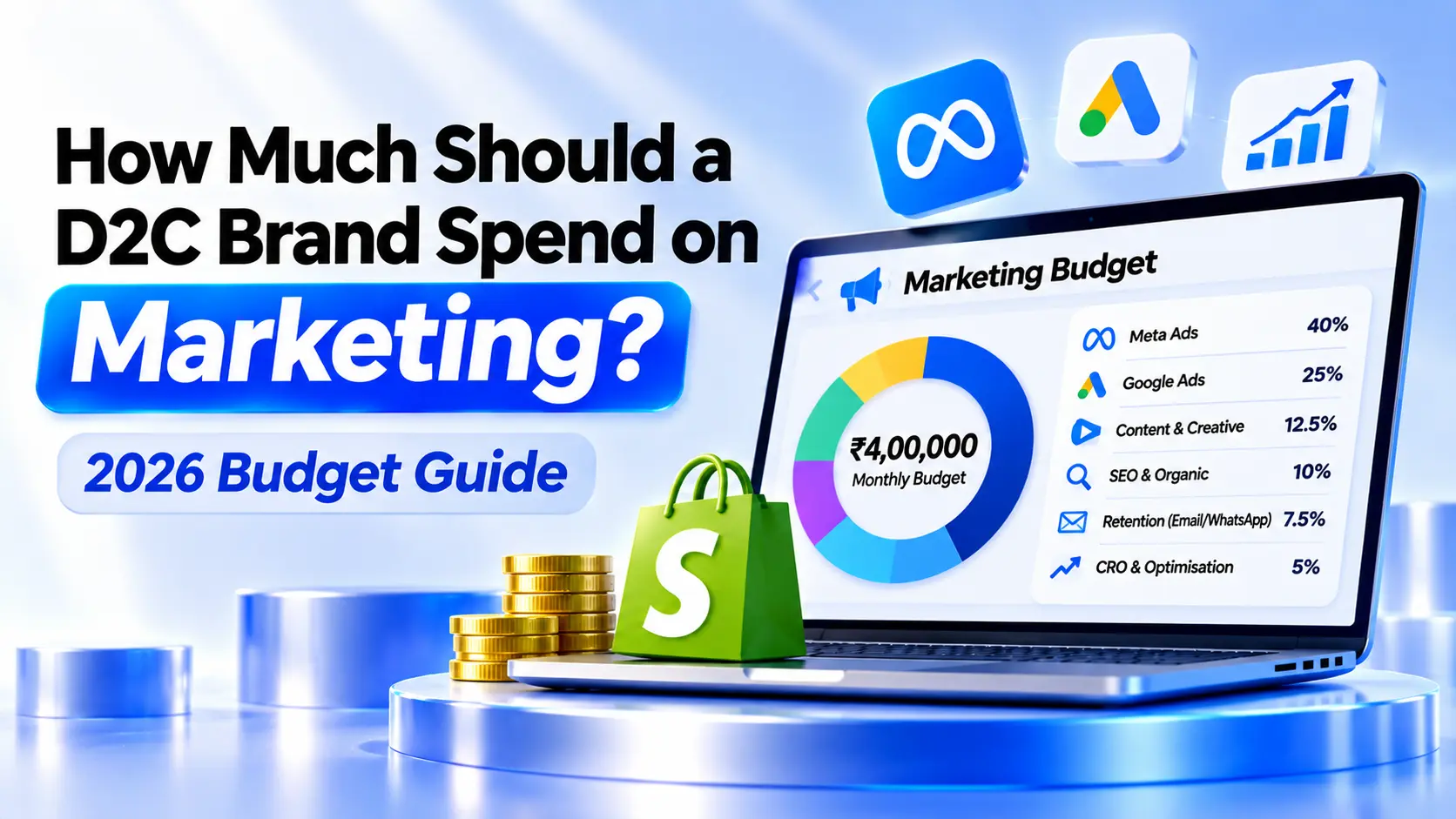
Consider a hypothetical brand with a ₹4 lakh monthly marketing budget.
Example Monthly Marketing Budget Allocation
| Marketing Activity | Allocation | Monthly Budget |
|---|---|---|
| Meta Ads | 40% | ₹1,60,000 |
| Google Ads | 25% | ₹1,00,000 |
| Content and Creative Production | 12.5% | ₹50,000 |
| SEO and Organic Growth | 10% | ₹40,000 |
| Email, WhatsApp and Retention | 7.5% | ₹30,000 |
| Conversion Rate Optimization | 5% | ₹20,000 |
| Total | 100% | ₹4,00,000 |
This allocation is an illustrative model for a brand prioritizing paid acquisition. It is not a universal recommendation.
A premium furniture brand may require more investment in product storytelling, photography, and search visibility.
A skincare brand may prioritize repeat purchases, creator content, and performance campaigns.
A fashion brand may need frequent creative testing, new collection campaigns, and strong social media engagement.
The correct channel mix depends on where your customers discover products and what influences their buying decisions.
4. Calculate Your Customer Acquisition Cost Before Increasing Spend
Before deciding how much to invest in marketing, every D2C founder should understand Customer Acquisition Cost (CAC).
CAC represents the cost of acquiring a new customer.
CAC = Customer Acquisition Costs ÷ New Customers Acquired
For example, suppose your brand spends ₹3 lakh on customer acquisition activities and acquires 500 new customers.
Your blended CAC is ₹600.
But knowing your CAC isn’t enough.
You need to understand whether your business can afford that acquisition cost.
Example: Understanding Customer Acquisition Profitability
Imagine your brand has the following economics:
| Metric | Value |
|---|---|
| Average Order Value | ₹2,000 |
| Product, Fulfilment and Variable Costs | ₹1,200 |
| Contribution Before Acquisition | ₹800 |
| Customer Acquisition Cost | ₹600 |
| Contribution After Acquisition | ₹200 |
In this simplified example, acquiring a customer contributes ₹200 before fixed operating expenses.
If CAC increases to ₹900, the first purchase creates a ₹100 contribution loss.
That loss may be acceptable in a deliberate customer lifetime value strategy, but only when repeat purchase economics and available cash support it.
Click400 Insight: Scaling revenue without understanding customer acquisition profitability can create a larger business with weaker financial performance.
5. How Much Should D2C Brands Spend on Meta Ads and Google Ads?
Meta and Google serve different purposes in the customer acquisition journey.
Meta Ads are often valuable for creating product discovery and generating demand through Facebook and Instagram.
Creative quality, audience relevance, product storytelling, and the customer journey play important roles in performance.
Google Ads can help capture existing purchasing intent through Search, Shopping, and other campaign formats.
The right balance depends on whether your audience is actively searching for your products or needs to discover your brand first.
A possible starting split for a paid media budget is:
- 60% Meta Ads and 40% Google Ads for a discovery-led brand.
- 40% Meta Ads and 60% Google Ads for a search-led brand.
These examples are starting hypotheses, not industry benchmarks.
An established brand should prioritize its own conversion data, customer acquisition costs, and incremental returns.
Avoid assuming that whichever platform reports the highest ROAS deserves the entire budget. Attribution methods differ, and multiple channels may influence the same purchase.
6. Your Website Conversion Rate Can Change How Much Marketing You Need
Here’s an overlooked aspect of D2C marketing budget planning.
Your ecommerce website can influence how efficiently your marketing investment generates revenue.
Imagine two Shopify brands receiving 50,000 monthly sessions.
Both have an average order value of ₹2,000.
| Metric | Brand A | Brand B |
|---|---|---|
| Monthly Sessions | 50,000 | 50,000 |
| Conversion Rate | 1.5% | 2.5% |
| Orders | 750 | 1,250 |
| Monthly Revenue | ₹15 lakh | ₹25 lakh |
Both brands receive identical traffic, but Brand B generates ₹10 lakh more gross revenue.
This is a hypothetical example assuming comparable traffic quality and unchanged average order value.
It illustrates how conversion performance can influence the revenue generated by existing traffic.
Before increasing advertising spend, evaluate your Shopify store’s product pages, mobile navigation, website speed, customer trust signals, and checkout experience.
For brands with an outdated or restrictive storefront, strategic Shopify development and conversion-focused design may improve the effectiveness of existing marketing activity.
7. Seven Smart Strategies to Optimize Your D2C Marketing Budget
Strategy 1: Set Revenue and Profitability Goals First
Begin with the financial outcome you want to achieve.
Consider expected revenue, gross margins, variable costs, customer acquisition expenses, and fixed operating costs.
A target such as ₹50 lakh monthly revenue becomes more meaningful when supported by a realistic acquisition and profitability model.
Strategy 2: Separate New Customer Acquisition From Retention
Acquiring a new customer and generating a repeat purchase involve different costs and customer behaviours.
Track new customer CAC, repeat purchase rate, customer lifetime value, and retention marketing performance separately.
This gives you a clearer picture of where your spending creates sustainable value.
Strategy 3: Invest in Creative Testing
Strong creative execution can influence paid campaign performance.
Instead of relying on one advertisement, test different product benefits, customer objections, visual formats, and storytelling approaches.
Evaluate creative performance using purchase quality and business outcomes, not only engagement metrics.
Strategy 4: Improve Your Shopify Conversion Rate
If your ads attract relevant visitors but customers struggle to buy, adding more traffic may simply increase marketing costs.
Review product discovery, mobile usability, product information, shipping transparency, and checkout friction.
Prioritize changes supported by customer behaviour and analytics.
Strategy 5: Build Organic Traffic Over Time
Paid advertising can generate traffic quickly, while organic search and useful content can help reduce dependence on continuously purchasing every visit.
Invest in technically sound SEO, helpful category content, product information, and educational resources.
Organic growth requires time and consistent execution, so it should complement rather than automatically replace paid acquisition.
Strategy 6: Reserve Budget for Experimentation
Don’t invest your entire marketing budget in campaigns simply because they performed well last month.
Keep a controlled portion available for testing new audience strategies, creative concepts, landing pages, and emerging opportunities.
Treat experiments as learning investments with measurable success criteria.
Strategy 7: Review Marketing Efficiency Regularly
A well-managed D2C marketing budget evolves with business performance.
Monitor customer acquisition cost, blended marketing efficiency, contribution margin, average order value, repeat purchase rate, and revenue trends.
Review both platform-level reporting and overall business results.
This prevents decisions based entirely on potentially incomplete advertising attribution.
8. When Should a D2C Brand Increase Its Marketing Budget?
Increasing spending makes sense when additional investment has a reasonable likelihood of producing acceptable incremental returns.
Positive signals may include:
- Customer acquisition costs remaining within profitable targets.
- Sufficient inventory and fulfilment capacity.
- Stable website conversion performance.
- Strong customer satisfaction and manageable return rates.
- Evidence that additional advertising investment can acquire customers efficiently.
However, if Meta Ads costs are rising, website conversion rates are declining, or average order value is falling, increasing budgets may amplify existing problems.
In those situations, improving efficiency should take priority over scaling expenditure.
A bigger marketing budget doesn’t automatically create a stronger D2C brand. A better-performing customer acquisition system does.
9. The Difference Between ROAS and Marketing Efficiency
Return on Ad Spend (ROAS) measures attributed revenue relative to advertising spend.
ROAS = Attributed Advertising Revenue ÷ Advertising Spend
Marketing Efficiency Ratio (MER), sometimes called blended ROAS, evaluates overall business revenue relative to advertising spend.
MER = Total Revenue ÷ Total Advertising Spend
For example:
A brand generates ₹30 lakh in monthly revenue while spending ₹6 lakh on advertising.
Its MER is 5X.
If total marketing expenses, including agencies, creative production, and software, are ₹8 lakh, the corresponding total marketing revenue-to-spend ratio is 3.75X.
These are different measurements and shouldn’t be compared without defining what expenses are included.
Neither automatically proves profitability.
Brands should connect marketing performance to contribution margins, customer acquisition economics, and cash flow.
10. Final Thoughts: Spend Smarter, Not Just More
So, how much should a D2C brand spend on marketing?
There isn’t one ideal percentage.
A brand with ₹10 lakh monthly revenue may need an entirely different strategy from a brand generating ₹1 crore per month.
The right D2C marketing budget depends on business maturity, product margins, customer acquisition costs, conversion performance, and growth objectives.
For established ecommerce businesses, the goal should move beyond simply increasing advertising investment.
It should be about building a more efficient growth system.
That means connecting performance marketing, customer experience, Shopify development, and retention strategies.
At Click400 Technologies, we help growing D2C brands build stronger ecommerce experiences through performance marketing, conversion-focused UI/UX design, custom Shopify development, and ecommerce growth strategies.
Before increasing your marketing budget, make sure your existing investment is working as effectively as possible.
Frequently Asked Questions
What percentage of revenue should a D2C brand spend on marketing?
There is no universal percentage. Businesses can evaluate different budget scenarios based on their margins, growth stage, acquisition costs, and retention performance. A percentage-of-revenue approach is a planning tool, not a substitute for profitability analysis.
Is ₹3 lakh per month enough for D2C marketing?
It can be, depending on the product category, acquisition costs, average order value, and growth objectives. A ₹3 lakh monthly budget may support focused campaigns, but its effectiveness depends on the brand’s unit economics and how the funds are allocated.
How much should a Shopify brand spend on Meta Ads?
The appropriate amount depends on customer acquisition economics, campaign performance, margins, and available budget. Start with a controlled testing plan and scale when incremental returns support further investment.
Should D2C brands invest more in Meta Ads or Google Ads?
Meta can help create demand through social discovery, while Google can capture existing search intent. The ideal allocation depends on product category, customer behaviour, creative strength, and measured performance.
What is a good marketing ROI for a D2C brand?
A good return is one that supports profitable and sustainable growth after accounting for acquisition costs, product margins, fulfilment, returns, and other relevant expenses. ROAS alone cannot determine whether marketing is profitable.
How often should D2C brands review their marketing budget?
Monitor campaign performance regularly, review blended acquisition economics at least monthly, and reassess overall marketing allocation quarterly or when business conditions materially change