

Blog
Best Shopify Shipping Rate Apps for E-commerce Stores
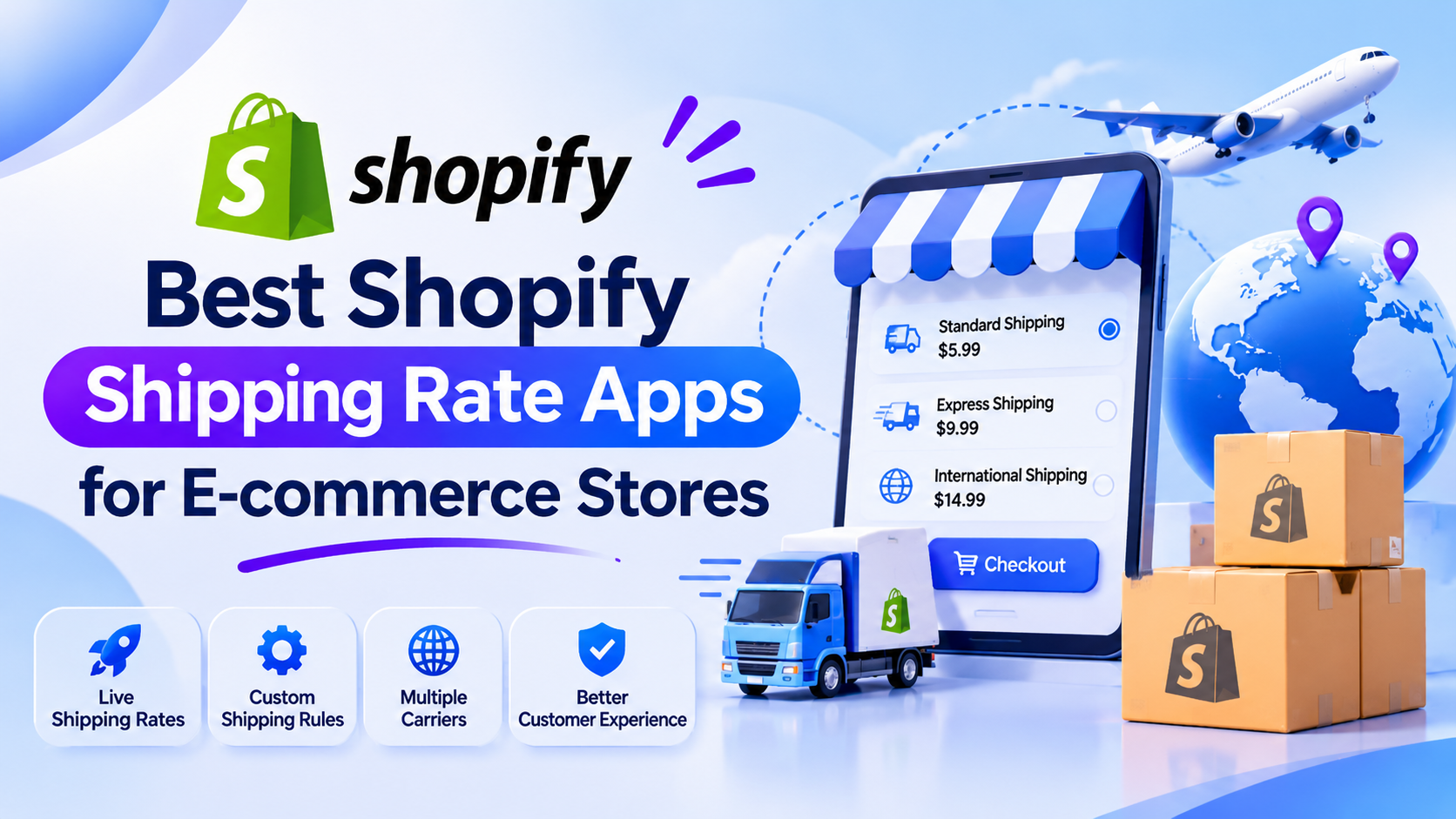
Shipping costs can influence whether customers complete their purchases or leave their carts behind. For Shopify merchants, displaying the right delivery price is equally important for protecting profit margins and maintaining a smooth checkout experience.
The Best Shopify Shipping Rate Apps help eCommerce businesses manage delivery charges through custom pricing rules, carrier integrations, live shipping rates, and automated calculations. Some focus on controlling the rates customers see at checkout, while others combine shipping calculations with labels, tracking, and international fulfilment. The right choice depends on your products, shipping destinations, carrier requirements, and order volume.
What Are Shopify Shipping Rate Apps?
Shopify shipping rate apps extend the platform's standard shipping settings with additional calculation and pricing capabilities.
Shopify already allows merchants to configure flat rates, free shipping, and weight- or order-value-based charges. These options can work well for stores with straightforward delivery requirements. However, businesses handling different product sizes, multiple shipping locations, or several carriers may need more flexible tools.
A Shopify shipping rate app can help merchants:
Calculate delivery charges using product weight, dimensions, quantity, or destination.
Display carrier-based shipping quotes at checkout.
Create custom rates for specific products, postcodes, or customer groups.
Apply shipping discounts, surcharges, and delivery restrictions.
Manage different shipping rules for multiple fulfilment locations.
Some Shopify shipping calculator apps also include label creation, order tracking, returns, and fulfilment automation. These additional tools can be useful, but they serve a different purpose from calculating the shipping price shown to customers. Merchants should check which capabilities are actually included in an app before installing it.
Best Shopify Shipping Rate Apps for E-commerce Stores
Each app below addresses a different shipping requirement. The comparison focuses on what merchants can use it for, rather than treating every option as interchangeable.
1. ShipX – Shipping Rules & Rates
ShipX is designed for Shopify merchants who need more control over how delivery charges are calculated. Instead of relying only on standard weight-based or flat rates, businesses can create conditions using product details, cart value, quantity, shipping origin, and postal codes.
One useful capability is rate blending, which allows eligible shipping charges to be combined when an order contains products with different shipping requirements. Merchants can also configure handling fees, remote-area surcharges, discounts, and restrictions for bulky products.
For example, a store selling both lightweight accessories and oversized products may need different delivery rules for each category. ShipX can help manage these conditions without requiring a separate manual shipping price for every product combination.
Key features:
Custom rates based on products, quantity, weight, and cart value.
Postcode and shipping-origin-based conditions.
Rate blending for eligible orders.
Handling fees, discounts, and shipping restrictions.
Integrations with supported carriers and shipping services.
2. Intuitive Shipping
Intuitive Shipping is a strong option for businesses with shipping requirements that go beyond basic rate configuration. It allows merchants to combine more than 40 conditions to control which shipping options appear at checkout and how their prices are calculated.
The app supports calculations based on product characteristics, weight, dimensions, quantity, distance, customer details, and delivery location. Its SmartBoxing feature helps determine suitable package sizes for dimensional shipping calculations.
This is particularly useful for stores selling products that require different packaging. A large product may occupy more space than its weight alone suggests, which can affect the carrier's final shipping charge.
Intuitive Shipping also supports rate blending, multiple shipping origins, and checkout rate customization. Its guided onboarding and sandbox environment give merchants an opportunity to configure and test shipping rules before using them for live orders.
Key features:
More than 40 conditions for controlling shipping rates.
Weight-, dimension-, product-, and location-based calculations.
SmartBoxing for dimensional shipping.
Rate blending and multiple shipping origins.
Custom shipping names and checkout descriptions.
3. PH MultiCarrier Shipping Label
PH MultiCarrier Shipping Label helps Shopify merchants connect different shipping carriers and manage important fulfilment tasks from one workflow.
Its carrier-calculated shipping feature can display available delivery rates at checkout using supported carrier services. This helps customers see shipping options based on their order and delivery destination rather than relying entirely on a fixed price.
The app also connects rate calculation with shipping label creation and tracking. Merchants can generate labels, automate fulfilment steps, and send shipment updates to customers.
For businesses working with more than one carrier, this can reduce the effort involved in switching between separate shipping platforms. However, the available carriers and rate features depend on the selected subscription and supported carrier accounts.
Key features:
Carrier-calculated shipping rates at checkout.
Support for multiple domestic and international carriers.
Shipping label creation and bulk printing on eligible plans.
Shipping automation rules.
Shipment tracking and customer notifications.
4. Easyship – All in One Shipping
Easyship is a shipping and fulfilment platform for merchants handling domestic and international orders. It brings carrier comparisons, shipping labels, tracking, and cross-border shipping tools into a connected workflow.
Merchants can compare supported carrier services based on shipping costs and delivery times. The platform also provides tools for customs documentation and import tax and duty calculations, with live duties and tax features available on eligible plans.
This makes Easyship relevant for businesses selling to customers across different countries. Instead of managing every carrier and international shipping task separately, merchants can handle many of these activities through one platform.
One important distinction is that not every Easyship plan includes live shipping rates at checkout. The free plan includes shipment management features, while displaying live rates requires an eligible paid plan.
Key features:
Shipping rate comparisons across supported carriers.
Discounted shipping services and carrier connections.
Shipping labels, tracking, and fulfilment automation.
Customs documentation and duties-related tools.
Live shipping rates and checkout duties on eligible plans.
5. ShipperHQ: Shipping & Checkout
ShipperHQ is built for merchants who need detailed control over shipping calculations and checkout delivery options. It supports a wide range of shipping conditions, making it suitable for stores with complicated fulfilment requirements.
Its dimensional shipping capabilities help calculate delivery charges based on package and product measurements. The platform also supports parcel and less-than-truckload (LTL) freight rates through eligible carrier integrations.
This can be particularly important for businesses selling furniture, machinery, large equipment, or other bulky products. Such shipments may have costs that cannot be estimated accurately using product weight alone.
Merchants can also create rules for surcharges, discounts, shipping restrictions, and delivery dates. These options help businesses manage different delivery requirements without relying on one general shipping rule.
Key features:
Carrier-based and dimensional shipping calculations.
Parcel and LTL freight support.
Product-, customer-, and location-based shipping rules.
Shipping discounts, surcharges, and restrictions.
Estimated delivery dates and local pickup options.
6. Zapiet – Rates by Zip Code
Zapiet – Rates by Zip Code is useful for merchants whose delivery charges depend on the customer's exact delivery area. Rather than applying the same rate across an entire country or region, businesses can configure delivery prices using ZIP codes, postcodes, Eircodes, or pincodes.
The app supports tiered pricing based on postal code, order weight, and order value. This gives merchants more control when delivery expenses vary between nearby and distant locations.
For example, a local business may charge one delivery fee for customers within its regular service area and a different amount for addresses farther away. It can also use postal-code conditions to restrict delivery where necessary.
The app integrates with Zapiet's Pickup + Delivery solution, making it relevant for merchants offering local delivery alongside in-store pickup.
Key features:
Delivery rates based on ZIP codes and postcodes.
Weight- and order-value-based pricing rules.
Advanced postal-code matching.
Multiple store-location support.
Translatable delivery rates.
Shopify Shipping Rate Apps Compared
The following comparison highlights the main strength of each app, helping merchants shortlist options based on their actual shipping needs.
App | Main capability | Best fit |
ShipX | Custom shipping rules and rate blending | Product-specific pricing |
Intuitive Shipping | Advanced calculations and SmartBoxing | Complex shipping requirements |
PH MultiCarrier | Carrier rates, labels, and tracking | Multi-carrier fulfilment |
Easyship | Carrier comparison and international shipping | Global eCommerce |
ShipperHQ | Dimensional rates and freight calculations | Bulky and oversized products |
Zapiet – Rates by Zip Code | Postal-code-based delivery pricing | Local and regional delivery |
These apps are not direct replacements for one another. Some focus on checkout rate calculations, while others combine shipping rates with fulfilment and international delivery services. The most suitable choice depends on the features your store actually needs.
How to Choose the Right Shopify Shipping Rate App
Choosing an app based only on its feature list can lead to unnecessary subscription costs or a complicated shipping setup. Before installing one, consider the following factors.
1. Understand Your Shipping Calculation Requirements
Start by identifying how your business determines delivery charges.
If you sell products with similar sizes and weights, basic custom shipping rules may be sufficient. If your catalogue includes products with different dimensions, packaging requirements, or delivery restrictions, you may need a more advanced Shopify shipping rate calculator.
Choose an app that supports your actual pricing conditions rather than paying for features you are unlikely to use.
2. Check Carrier and Shipping Region Compatibility
A shipping app may support several carriers, but that does not mean every carrier service is available in every country.
Confirm that the app works with your preferred shipping providers, fulfilment locations, and delivery destinations. International merchants should also check whether the platform supports the customs and duties features required for their target markets.
3. Understand Shopify Carrier-Calculated Shipping Requirements
Some Shopify shipping rate apps use third-party carrier-calculated shipping (CCS) to display carrier rates at checkout.
As of November 2026, Shopify includes third-party CCS with Advanced and Plus plans. Grow merchants can add the feature for an additional monthly fee or receive it through eligible annual billing. It is not included with the other plans.
This requirement does not apply in exactly the same way to every shipping feature. Some apps can create custom rates without connecting a third-party carrier account, while their live carrier-rate functionality may require CCS.
Before purchasing an app, check whether the feature you need depends on Shopify CCS, a supported carrier account, or a particular app subscription.
4. Compare Subscription Costs and Usage Limits
The monthly subscription is only one part of the total cost. Some apps also limit monthly shipments, rate calculations, carrier connections, or advanced features.
Compare the plan limits with your average order volume. Also check whether carrier charges, shipping labels, or external service fees are billed separately.
An app that appears inexpensive may become less cost-effective if your store regularly exceeds its included limits.
5. Test the Rates Before Going Live
Never assume that an app will calculate every order correctly immediately after installation.
Test different products, package sizes, shipping destinations, and mixed-product carts. Check whether the rates displayed at checkout match the delivery services your business can actually provide.
Accurate product weights, package dimensions, shipping origins, and shipping zones are essential for reliable calculations. Shopify also recommends checking these details when carrier or app rates do not appear as expected.
Conclusion
The Best Shopify Shipping Rate Apps are not necessarily the ones with the longest feature lists. They are the solutions that fit your products, delivery destinations, carrier requirements, and fulfilment process.
ShipX and Intuitive Shipping are worth considering for custom rate calculations and advanced shipping rules. PH MultiCarrier is useful for businesses managing multiple carriers and labels, while Easyship supports international fulfilment. ShipperHQ offers more detailed options for dimensional and freight shipping, and Zapiet – Rates by Zip Code is suited to postcode-based delivery pricing.
Before making a decision, compare the actual checkout features, Shopify plan requirements, carrier compatibility, and subscription limits. The right Shopify shipping rate app should make delivery pricing easier to manage while giving customers clear and reliable shipping options.
Share this article
You May Also Like
Related Articles